
Concerns linger after transformer spill
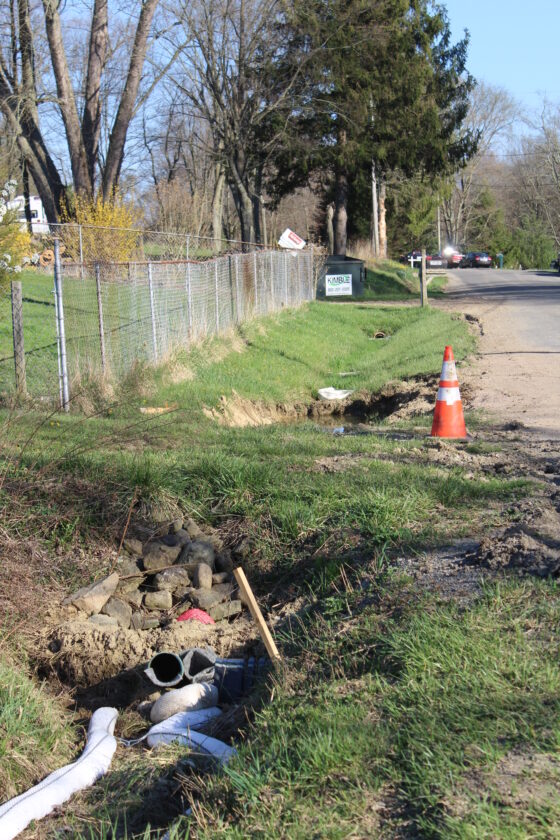
Absorbent booms from the Ohio Environmental Protection Agency’s response to a possible PCB spill remain on Campbell Road in Hanoverton. (Photo by Stephanie Elverd)
When high winds swept through the area on March 25, the gust brought down a utility pole on Campbell Road in Hanoverton. With the utility came a transformer – a transformer manufactured and installed before 1979. The transformer split from the bottom and spilled polychlorinated biphenyls or PCBs onto the street and into the streams that run through and behind the property of Keith and Jamiella Hilderbrand.
It’s been over 20 days since the transformer fell and the Hilderbrands say they have been left hanging – not knowing if their land or water has been poisoned. The little information they have received has been conflicting, they say.
“We were told the water is safe, but we were also told they would be testing it on a weekly basis,” Jamiella said. “So are we supposed to keep drinking it, cooking with it and bathing with it for them to turn around and tell us next month that it is contaminated? We don’t feel safe drinking it.”
The Hilderbrands were without access to water for 13 days. The power on Campbell Road was not restored until March 31. No electric power meant no way to turn on the pump and no way for Ohio Edison’s contractor to test the water and soil for PCBs. Those results, according to Ohio Edison Lauren Siburkis, have returned no cause for alarm.
“The safety and well-being of our community is most important to us. We understand the concerns this property owner has regarding the recent spill and we will continue our work to ensure it’s not a threat to our local environment,” she stated via email. “We’ve executed a thorough remediation plan at the property and the soil samples are showing promising results of being clean. We will continue testing soil at this property in the future to ensure it remains free of PCB.”
PCBs are toxic and persistent chemicals that were primarily used as insulating fluids in heavy-duty electrical equipment, power plants, industries, large buildings and transformers before 1980. In 1979, the Environmental Protection Agency banned the manufacture of polychlorinated biphenyls (PCBs) and began phasing out PCB uses.
The PCBs from the downed transformer leaked for 36 hours, slowly draining 40 gallons of toxic oil from the canister and into the drainpipe across the road from Hilderbrands. The oil water ran beneath the Hilderbrand’s yard and into the stream that cuts through their yard. That stream served as a watering hole for the couple’s goats. Jamiella said she was forced to surrender four of the goats to the EPA. Jamiella had hoped the goats would be tested and quarantined but she was told the animals would have to be euthanized. She said on Thursday she received confirmation that the goats had been put down.
“That’s been the worst part of it,” she said. “It broke my heart when I was told they were in fact gone.”
Jamiella still worries about her dogs and remaining livestock. Keith worries about the property value of his home. They both worry about their grandchildren and their own health. They refuse to drink the water.
“We don’t feel the water is safe,” Keith said. “We were told when this happened the PCBs were measuring at 138 ppm. A safe level is considered 50 ppm.”
According to the Ohio Environmental Protection Agency, Ohio Edison hired an environmental contractor to remediate the area around the downed transformer and testing of the Hilderbrand’s well water and the stream “tested as non-detect for PCBs.” One sample did test positive, but the EPA reported it was below the allowable limit. Efforts to contain any contaminants in the stream were made.
“Absorbent booms were placed downstream of the fallen transformer to contain any liquid from the transformer that leaked into the stream,” the EPA statement explained. “Vacuum pumps were used to remove oil from the on-site sump, drain tiles and stream. Soil remediation is ongoing. Post-remediation samples will be taken by the environmental contractor after all of the impacted soil has been removed.”
The Columbiana County Health Department also conducted water tests, but as of press time, those results were still out. Department spokesperson, Laura Fauss, directed questions to the Ohio EPA as the agency in charge of response and remediation.
The EPA insists the water and soil on Campbell Road are safe.
The Hilderbrands are not taking any chances. Jamiella’s request for a water buffalo was denied by Ohio Edison as the couple waited 13 days without water. Keith’s request for a carbon filter for the Hilderbrand’s water well was also denied. Keith decided it was too risky to not install the filtration system so the couple paid for it themselves.
“I really thought Ohio Edison would do the right thing. The right thing was a carbon filter,” Keith said. “The right thing is not leaving us in limbo. We don’t know what to do right now.”
While waiting the 13 days, Jamiella said Ohio Edison’s only offering was three cases of water.
“Three cases, that was it,” she said. “We spent 13 days flushing our toilets with water from the creek. We cooked with bottled water. We had to take showers at other people’s houses. I can’t tell you how much money I had to spend at the laundromat. It’s been so stressful. I don’t think there has been one day since that transformer fell that I haven’t broken down in tears. I’ve been upset everyday.”
Keith is upset, too. He is downright angry.
“I expected Ohio Edison to fix it. I still do,” he said. “It was their transformer and this is their mess. They need to fix it.”
selverd@mojonews.com
Local News
Upgrades expected at the Ward Athletic Complex
COLUMBIANA — Several upgrades are expected to be made at the Ward Athletic Complex in the coming ...
CCCTC enters into oil and gas lease
LISBON — The Columbiana County Career and Technical Center has entered into an oil and gas lease for 52.77 acres ...

West Branch High School 2026 Commencement

Dr. Marcela Purtell returns to SRMC Primary Care-Calcutta
Salem man accused of raping children to have competency evaluated
LISBON —A Salem man accused of rape and multiple other sex-related acts against two children was ordered ...
Columbiana County Park Board: Then there were none
LISBON — The Columbiana County Park District Board has no members as of Friday. Columbiana County Probate Court ...