
East Palestine dioxin levels higher on new independent test
Trending
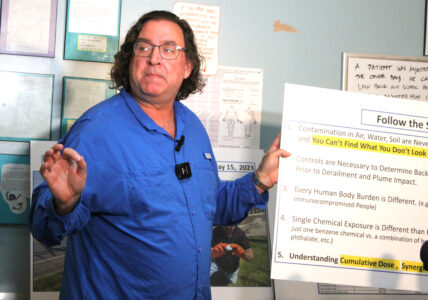
Concentrating on one property close to the derailment site of February's Norfolk Southern train derailment, independent scientist Scott Smith reported to East Palestine residents Wednesday in Darlington that independent soil sampling conducted by his team at Eco Integrated Technologies shows dioxin levels up to 154,000 times control samples. Smith was able to compare post-derailment samples from 885 E. Taggart St. from May 15 to a current sample from Salem and a pre-derailment sample from Negley.
"This clearly indicates that the burden of dioxins on this community has increased significantly post derailment," Smith said.
The Environmental Protection Agency conducted its own dioxin monitoring, sampling soil in and around East Palestine in April. Soil was sampled and tested at 148 residential, recreational, commercial and agricultural locations, 89 from Ohio and 59 from Pennsylvania. The EPA released the preliminary data on April 21 which indicated median results in East Palestine were 4.8 parts per trillion (ppt). Dioxin levels were measured anywhere from 2.6 to 14 ppt in and around East Palestine. Levels in Pennsylvania returned results as higher than 100 ppt, but the numbers were still below action levels.
Smith's data from the East Taggart Street sample differed wildly. His results show 1,900 ppt TEQ while the Salem control registered a 4.0 and the Negley pre-derailment measured 2.9.
The EPA determined in 1989 that dioxin soil concentrations of less than 1,000 ppt were safe for residential areas and between 5,000 to 20,000 ppt in commercial and industrial soil. Anything above those levels would trigger a cleanup and remediation.
The agency tried to change that threshold a decade ago. In 2010, the EPA asked to lower that preliminary remediation goals for dioxin in soils to 72 ppt for residential soil and 950 ppt for commercial/industrial soil. The EPA considered lowering those numbers even further to 3.7 ppt toxic equivalency (TEQ) in residential soil and 17 ppt TEQ in commercial/industrial soil. However, the 1989 threshold still stands. Ohio uses the federal standard though some states require cleanup as low as 50 ppt.
Smith insists the Environmental Protection Agency dioxin testing should have continued as remediation on the site did. He also said that EPA samples were too deep to detect dioxins on the surface.
"The EPA did dioxin testing in April but they stopped on or about the 14th," Smith said. "They are going six inches below the surface, but if you want to know what's going with all the dust, you don't want to go that deep in the soil because that can be altering the results and not reflecting exactly what people are being exposed to."
The EPA has repeatedly rebuffed requests for continuous dioxin testing in and around East Palestine, maintaining that dioxins -- environmental pollutants created as a byproduct of combustion known to cause cancer at high levels -- are persistently present in the environment. The EPA has said the East Palestine numbers are consistent with typical background levels of dioxins that are created by any combustion processes. That combustion can be as simple as smoking a cigarette or cooking out in your backyard.
"We know we're all exposed to it. When we sit around a campfire, we're exposed to it," said Region 5 EPA Response Coordinator Mark Durno when the preliminary results were released. "This is no different, when we're exposed to these soils, we're exposed at very low levels."
According to Durno, at the level that dioxins were measured in the soil in and around East Palestine, harm would only occur from continuous exposure.
"You're talking about exposure 365 days a year, 24 hours a day at the level of 4.8. That's not realistic," Durno added.
Smith disagreed.
"I keep hearing the EPA talk about dioxins being ubiquitous in the environment, but these health symptoms were not ubiquitous in the environment prior to the derailment," he said. "What is special about dioxins is that they bioaccumulate and everybody has a different burden and accumulation increases that burden."
Residents have reported persistent nosebleeds, headaches, rashes, eye irritation, respiratory difficulties and digestive issues as well other ailments since the derailment.
Smith aside from the bioaccumulation of the dioxins, Smith said synergism -- the effect caused when exposure to two or more chemicals at one time results in health effects that are greater than the sum of the effects of the individual chemicals -- is also a concern for East Palestine and surrounding communities.
"Single exposure is different from multiple-chemical exposure. You have heard the EPA and other agencies reference a singular exposure to a singular chemical. There have been about 50 chemicals involved," Smith said. "There are no health standards for a combination of chemicals. For every 10 chemicals there are a thousand different combinations, Synergistic toxicity is all these chemicals combined and then you add prescriptions -- blood pressure medication, cholesterol medication -- those can combine with minor amounts of some of these chemicals and create reactions."
Ultimately Smith said it isn't his intention to work against the EPA, but rather the opposite. He hopes to work alongside them.
"We are trying to follow the science. We are trying to work in good faith with the railroad and with the EPA," he said. "What I would like to see more than anything is a positive outcome and all the stakeholders move forward in a transparent way to help this community."
selverd@mojonews.com