
Future training center will make rails safer
Trending
During a two-day field hearing held at East Palestine High School to investigate the events that led up and unfolded after last year's Norfolk Southern train derailment, East Palestine Fire Chief Keith Drabrick told the National Transportation Safety Board that "I don't think you can ever be prepared for something like this."
While Drabrick couldn't have imagined such a catastrophe before Feb. 3, he's made it his mission to make sure other emergency responders are not faced with the chaos his crews faced in the minutes following the fiery crash of 38 rail cars. That mission was to spearhead an innovative training specialized for first responders. Ground was officially broken on that mission in September.
The Norfolk Southern First Responder Training Center, which will be located at the former site of the Jasar Recycling facility located on Edgeworth Ave,will provide ongoing, free training to first responders from Ohio, Pennsylvania, West Virginia and the greater region. The center -- construction is expected to be completed by the end of this year --will offer traditional fire-service training to all first-responders but more importantly it will offer specialized training for rail response and other transportational-related hazmat emergencies.
However, the center will also provide training for a wide range of emergencies and provide training in both challenging and diverse environments. The acquisition of the Jasar property not only provided the acres needed to construct such a facility, it also provided pre-existing buildings that will be fabricated to mirror real-life locations like classrooms for active shootings scenarios and warehouses for complex structure-fire situations. The facility will also be the future home of the East Palestine Fire Department which will eventually relocate to the center.
Drabick's drive to see to it that such a training center was built was rooted in the confusion that first responders faced that night. It took nearly an hour for word of what was on the train to reach emergency crews on the ground. Even then, procedure and protocol was muddled by a breakdown in communication and absolute chaos as the fire raged. First responders immediately did what they were trained to that night -- respond. They did so without any consideration for their own safety and unfortunately without the adequate tools to extinguish the chemical flames.
The training center will not only enhance safety for the communities that are located along Norfolk Southern's nearly 20,000 miles of track, but will enhance first responder safety through adequate training in the unfortunate event that history does repeat itself.
Drabrick said the training center, which will be built from a $25 million contribution from Norfolk Southern, will be a game-changer for the emergency crews near and far, especially volunteer first responders who often don't have time for or can't afford more extensive training.
"This is huge, but it's not just huge for East Palestine. It's huge for the first-responding community as a whole, from the tri-state area to the East Coast," Drabrick said at the groundbreaking. "We are going to focus on the volunteers-side. Sometimes, it's hard for them to get the classes that they need plus work full time. So that's an emphasis -- to focus on the volunteer firefighting community and make it available and affordable and easy for them to come here and get the training they need to be successful."
Volunteer firefighters receive only 36 hours of initial training when they are certified while professional firefighters receive 200 hours and no hazardous materials training is included. Nearly 400 first responders rushed to East Palestine when the call went out - the majority of which were volunteers.
The training center is just one of many ways rail safety has been improved in the wake of the East Palestine disaster.
Days before the groundbreaking for the first responder training center, the Association of American Railroads (AAR), working with Norfolk Southern, integrated AskRail into the Columbiana County and Beaver County emergency management agencies (EMAs) dispatching services.
AskRail is a software that can instantly provide anyone with access to it with accurate up-to-date data of a train car's contents and the dangers of that cargo. Launched in 2014 as a collaborative, the mobile app was developed in partnership with the emergency response community to deliver information that the AAR said "empowers first responders to make informed decisions swiftly during a rail emergency."
The process is sophisticated yet simple. A rail car's identifying number is typed into a search bar on the application's homepage. Almost instantaneously, the car's cargo, complete with the total weight of its contents in pounds and the type of car, is displayed. The cargo is immediately determined to be hazardous or non-hazardous and further identified as flammable or explosive. An emergency contact number for the railroad is also displayed which, when clicked, the link places a direct call. With one click, a user can also access health dangers associated with the contents and access the universal emergency response guide (ERG) set by the Pipeline and Hazardous Materials Safety Administration (PHMSA), including the suggested evacuation distance. With another click, the user can pinpoint the exact evaluation zone which is displayed on an interactive map. The user can also immediately view the entire consist (what is in or on each and every car) of the train in a list-view with hazardous cars highlighted. The app can also be installed on first responder cell phones, but by integrating AskRail into the county dispatch and EMA dispatchers can access the application at their desks and relay pertinent to first responders in the field or en route.
While Norfolk Southern has helped fund both the training center and the installation of AskRail, the railroad has also taken steps to make their operations safer.
In September, Norfolk Southern deployed its first Digital Train Inspection Portal in Leetonia, just 11 miles from the derailment site. The railroad plans to install 17 portals -- one every thousand miles or less -- by early next year. Currently five portals are under construction and near completion along the eastern United States.
The portal was developed in concert with the Georgia Tech Research Institution and uses advanced machine-visioning technology and artificial intelligence to find potential defects on moving trains. As a train passes through the portal -- which resembles a modern highway tollbooth housed in a tunnel-like structure with high-powered stadium lighting -- 38 high-resolution cameras capture more than 1,000 images of each rail car from different angles for a full 360-degree view while the train is at full speed. AI then analyzes the images for potential defects in practical real time. If a defect is detected, the information is relayed to the network operating center and passed on to train crews in a matter of minutes. Depending on that information and specific suspected defect, proper safety protocol is put into action, and hopefully, a potential disaster prevented.
The portals have been in development for years, but were fast-tracked following February's rail disaster. Originally, the portal's pilot site was located in Atlanta near the corporation's headquarters, but the decision was made to launch the prototype in Columbiana County.
"In the wake of EP it made sense to come up here. Another justifying factor was that this is our high-density line segment across our entire network," Norfolk Southern Vice President of Safety John Fleps said the day portal was unveiled. "There are upward of 80 to 90 trains a day that traverse this line. This is our premier corridor. It was an easy decision when we had a chance to rethink it coming out of EP."
An addition to the portal, Norfolk Southern installed 250 additional hotbox detectors since the events of Feb. 3.
The portals and supplemental hotbox detectors are part of a $50 million investment by Norfolk Southern in the wake of the derailment. That investment also includes other wayside equipment, including acoustic detectors that would have picked up the overheated-wheel bearing -- the suspected cause of the East Palestine derailment -- as well as expanding employee training and advancing technology to survey the integrity of infrastructure -- track, bridges and tunnels on the Norfolk Southern network.
"The communities we operate through expect to operate every single day, 365 days a year, year after year, without incident, and that's our goal," Fleps added. "An incident like East Palestine is incredibly rare, but one is too many and we are committed to having something like that not happen again. We are investing in technology, we are investing in our people and investing in our infrastructure to help take that safety to another level."
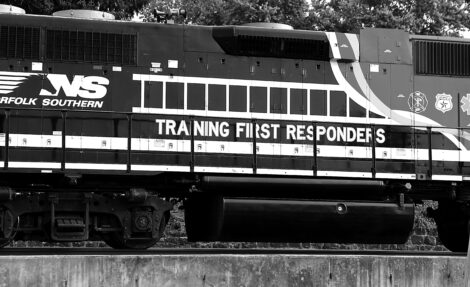
Norfolk Southern First Responder Training Center at the former site of the Jasar Recycling facility located on Edgeworth Avenue in East Palestine over the summer. The center will provide regional first responders specialized and enhanced training in a wide range of emergency scenarios. Norfolk Southern CEO Alan Shaw, pictured above, committed a $25 million investment from the railroad to help fund the facility. (Photo by Stephanie Elverd)