
Hunter Associates hosts Hansen, McClean as guest speakers
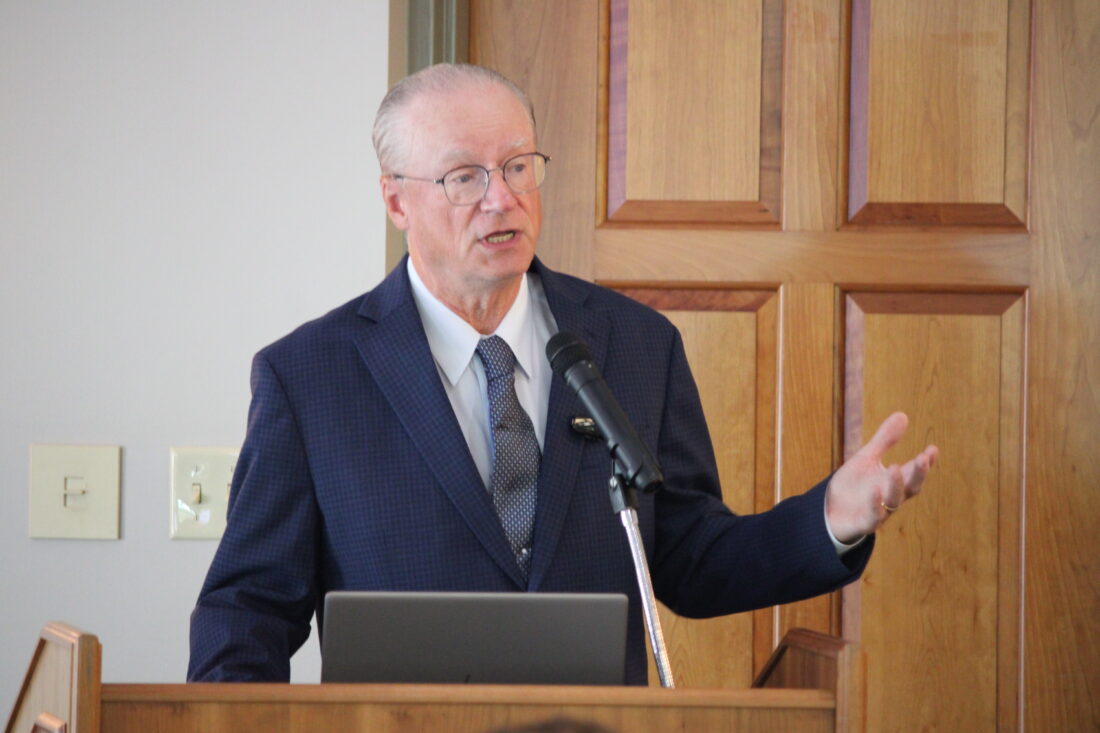
James R. Hanson, an award-winning author and Professor Emeritus of History at Auburn University, served as one of the guest speakers for a recent client appreciation event held by Hunter Associates, giving a lecture highlighting the surprising similarities and difference between Charles Lindburgh and Neil Armstrong. (Photo by Morgan Ahart)
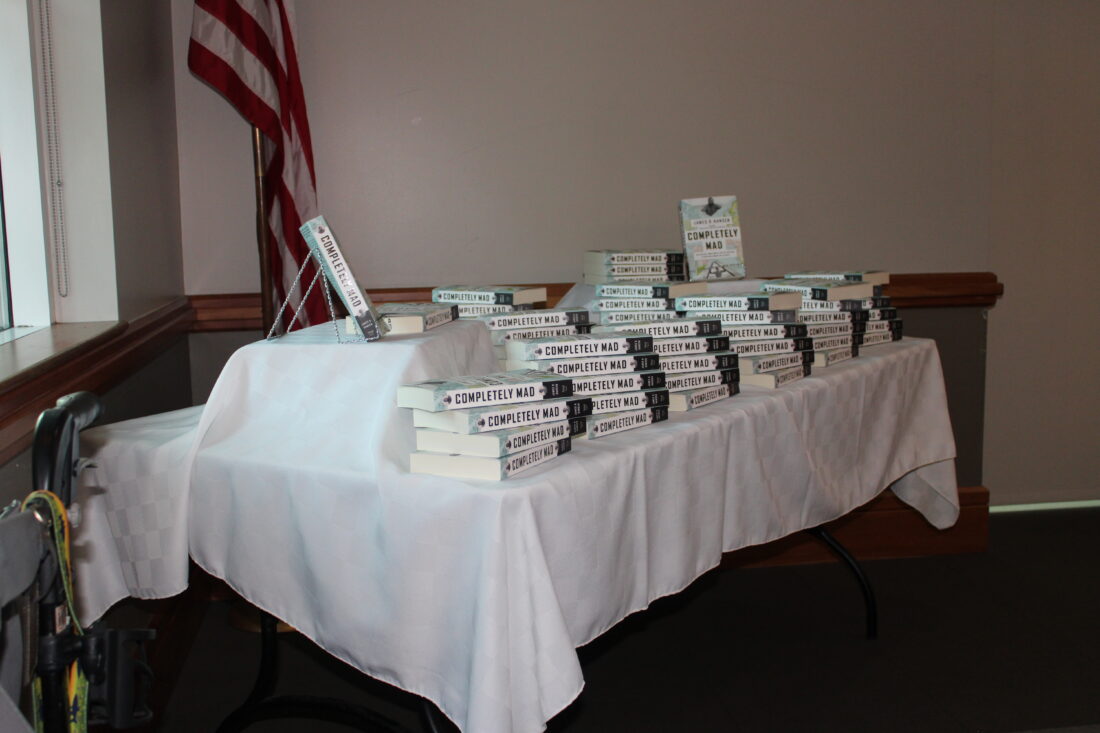
Each attendee of the Hunter Associates Client Appreciation Event received a copy of “Completely Mad Tom McClean, John Fairfax, and the Epic Race to Row Solo Across the Atlantic” signed by both Hansen and McClean. (Photo by Morgan Ahart)
James R. Hanson, an award-winning author and Professor Emeritus of History at Auburn University, served as one of the guest speakers for a recent client appreciation event held by Hunter Associates, giving a lecture highlighting the surprising similarities and difference between Charles Lindburgh and Neil Armstrong. (Photo by Morgan Ahart)
Each attendee of the Hunter Associates Client Appreciation Event received a copy of “Completely Mad Tom McClean, John Fairfax, and the Epic Race to Row Solo Across the Atlantic” signed by both Hansen and McClean. (Photo by Morgan Ahart)
Trending
SALEM – An award-winning author and a record-setting adventurer recently visited Salem.
James R. Hanson, author and Professor Emeritus of History at Auburn University, well-known for his work on aerospace history and biographical work on Neil Armstrong; and Tom McClean, the first man to solo row across the Atlantic unassisted, served as special guest speakers for Hunter Associates Client Appreciation Event on Sept. 7.
While Hansen is best known for his 2005 Armstrong biography, "First Man: The Life of Neil A. Armstrong," a New York Times best seller which was adapted for the silver screen in 2018, Hunter Associates Vice Chairman Robert McCulloch said that he became aware of his work from a Wall Street Journal review of Hansen's most recent book, "Completely Mad Tom McClean, John Fairfax, and the Epic Race to Row Solo Across the Atlantic," which chronicles the parallel journeys of McClean and Fairfax as they separately set out to become the first man to row across the Atlantic Ocean alone. McCulloch said that after reading Hansen's book he was able to get McClean's home phone through his motivational speaking business to request he speak for the event, eventually staying with him at his home in Morar Scotland for two nights.
"I've met and stayed with the McCleans and Tom really is the real deal," said McCulloch.
"The real deal" is an apt description for the now 82-year-old McClean, who was only 26 at the time of his historic row in 1969. An orphan, McClean joined the British Army at 17 serving in the Parachute Regiment and Special Air Service during his military career, completing his row from St. Johns Newfoundland on May 17 to Blacksod Bay Ireland on July 27 in just 70 days.
"First was the orphanage, then the [Paratroopers Regiment], then the Special Forces. I see that as great training for an individual hard guy to take on lone adventures," said McClain.
Hansen said that during his research into the Apollo 11 astronauts he learned that they had read a story in the Miami Herald about John Fairfax's row from the Canary Islands to Hollywood Beach, Florida, and quickly learned of McClean's row, which despite starting over 100 days later was concurrent to that of Fairfax, and finished just over a week after Fairfax landed on July 19.
"I started thinking, well maybe there's a book there you know, but in my research very early on I came to understand that there was another man doing the same sort of thing that had left from Newfoundland with Ireland on his destination, so there were actually two guys on the water at the same year the moon landing was taking place…and they both had written memoirs, but their two stories had never really been put together," said Hansen.
While Fairfax may have completed his row first, Hansen and McClain said that he got out of his boat and boarded passing vessels, receiving resupplies and taking breaks 10 times, while McClain never left his vessel and held the title of the first unassisted transatlantic solo row as a result.
"Unassisted is the important part, you don't get any resupply or breaks from other ships passing," said McClain.
Hansen wrote the book over the course of a roughly one-and-a-half-year period during the Covid-19 pandemic, interviewing McClean through services like Skype, noting that it had served as a means of mental escape while in quarantine. Hansen said that while it is fundamentally an adventure story, the book is more interested in the lives and motivations of Fairfax and McClean.
"It's really more the backstories of the two men - who they were - and I think the question was, 'what kind of person does this type of thing?' That's why I wrote the book," said Hanson.
McClean said his motivation was quite simple - he was seeking an adventure - and two of his fellow paratroopers, Captain John Ridgeway and his former Platoon Seargeant in the Parachute Regiment Chay Blyth, had recently completed their own historic two-man transatlantic row.
"They rowed from Cape Cod to the Aran Islands, as a twosome and it gave me an inkling, but by that time I was going into the Special Forces, so I waited until I was coming out and I bought some charts, and my OC says 'what's all these charts McClain?,' and I said I was thinking of rowing the ocean when I get out maybe but I would like to do it now," said McClain. "He said I've got an interview with the Commanding Officer, and he said 'all right come back in two weeks and give me the plan, boat, route, equipment, agent, all that sort of stuff.' I came back after seeing Ridgeway and Blyth. Ridgeway said I was mad and there's no way you could do it by yourself, but [Blyth] says 'you're a tough cookie, tie yourself to the boat and you'll come back with the boat,' so they wrote to the War office in London and got permission for 100 days of unpaid leave, so I went ahead," said McClain.
McClain chose a modified Yorkshire Dory for his row named Super Silver, a type of flat-bottomed, keelless boat that rides along the top of the water rather than pushing through it and becomes more stable as it is laden down with weight. Silver had its gunwales raised nine inches and additional turtle decking added for increased stability. McClain said that the most important thing for an ocean row was conditioning, technique, and mindset, noting that he had once attempted to count the number of strokes he made in a day and stopped counting at 24,000.
"Attitude's the big part, most people would last a week or two and think, "what am I doing out here,' and crack up," said McClain.
While McClain said he was never afraid during his row, the closest he came was when Silver became entangled in the sea anchor and overturned, forcing him to haul himself back into the boat as it righted itself and bail the water out for the next few hours, leaving one of only five sets of triple sealed clothing and himself soaked through for the next several days. When McClain arrived at Blacksod Bay in the early morning hours, nobody was there to greet him, sending him on a quest for a phone from a beachside cabin to a deserted local pub, to the lighthouse, where the keeper Ted Sweeney took McClain in and moored Silver while McClain used his phone to report his arrival.
McClain said upon his return to England he was met by Sir David Stirling, the founder of the Special Air Services, and through his assistance obtained the property on the shores of Loc Nevis where McClean's Ardintigh Adventure Centre remains to this day.
"He said 'Tom, well done, I've got you a little party,' and we've been friends ever since. It was through him that I got the land in Scotland for the training center, his cousin is Lord Lovat, and he said to his [agent] 'we've got Tom here, he needs a bit of land for his outdoor center,' and he told him that they don't sell land or even rent it, and he says 'well you do now' so it worked out well, and we stayed friends and I attend his grave in Morar,'" said McClean.
Hansen said that nothing was official, but a film adaptation of the book is currently in the works, with several notable names discussed to play McClain including Taron Egerton and Barry Keoghan.