
Salem school board approves five-year forecast
SALEM — The Salem School district’s five-year forecast has projected a mixed future for the district’s end of year cash balance amid turbulent state budget discussions which could significantly impact the financial future of public schools.
Treasurer Mike Douglas presented the board with the second half of the annual five-year forecast in its May meeting. In the state of Ohio, school districts are required to submit a five-year forecast to the state in October and then revise the report in May each year; with the intention of helping districts manage their financial resources. The figures are based on the district’s current revenue and expenditures and are projected out to five years.
“Basically, it tries to project our future based on a snapshot of today,” said Douglas.
While the forecast is always an estimate, Douglas stressed that it was particularly important to remember that this year as the state is currently still debating the biennial budget for the next two years. He said that the district will not have access to the details of a completed budget, including potential property tax changes, until October or November after the budget is approved in June, noting that it’s very difficult to accurately predict a five-year period when it is unclear what the state government will do in any two-year budget period. Douglas also noted that the current draft of the budget calls for a $103 million cut in funding to public school and an increase of $448 million in vouchers for private schools, and that there were currently 14 proposed laws which could affect local property valuations or property taxes and public school funding with it.
The most serious of these laws being House Bill 96, which would eliminate the fair school funding plan, suspending the fifth and sixth year of the plan. It would also limit school districts’ annual carryover cash balance to 30% of the prior fiscal year’s expenditures and empower the county budget commission to modify the collection of levies which have already been approved by voters.
“It empowers the commission to suspend approved ballot issues, which were put in front of voters and approved for funding public education, and allow them to disregard what the voters did and adjust the millage down to collect less dollar to ensure that in their opinion it is not over collecting what the voters approved,” said Douglas. “This
property tax implication of House Bill 96 would obviously be devastating to public schools because it would be a seesaw effect of the commission lowering millage, falling below [expenses] then all of a sudden, your millage goes up. You as property owners would also never be able to get a full feel of what your tax bill is going to be every year, one year it may be less and next year it goes back up.”
Amid this budget turbulence, the five-year forecast currently projects continued increases to the district’s end of year cash balance for the next three years, with a projected final balance for fiscal year 2025 of $8,841,595, an approximately 39% increase from fiscal year 2024’s final balance of $6,686,163. Fiscal year 2026 and 2027 are expected to continue this trend with projected balances of $10,181,460 and $10,856,222 respectively; however, the balance is expected to begin a decline in 2028 as expenses begin to outpace revenues with a projected balance of $10,751,559, which will continue in 2029 with $9,889,324.
State funding continues to comprise the majority of the district’s funding at 54%, with real estate taxes the second largest share at 37.3%. The district’s largest expenditures continue to be employee wages and benefits at 51% and 24%, respectively.
The board of education will meet next at 7 p.m. June 23.
Local News

Columbiana middle school students, community celebrate magazine ranking
Direct payments released in EP derailment settlement
EAST PALESTINE (WKBN) – Class action payments in the East Palestine train derailment lawsuit that have been held ...
Salem council scheduled special meeting Tuesday
SALEM — City council will hold a special meeting Tuesday to review several pieces of legislation. Council will ...
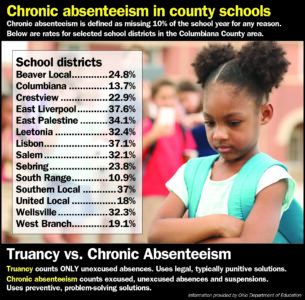
School districts battle chronic absenteeism
Lisbon BOE approves maintenance projects
LISBON — Lisbon school board members approved some maintenance projects during their recent meeting, including ...
Status hearing continued for Illinois man charged with child porn possession after changing attorneys
LISBON —A status hearing Friday was continued after an Illinois man charged for allegedly possessing images of ...