
Railroad says stream cleanup complete as EPA reviews final report
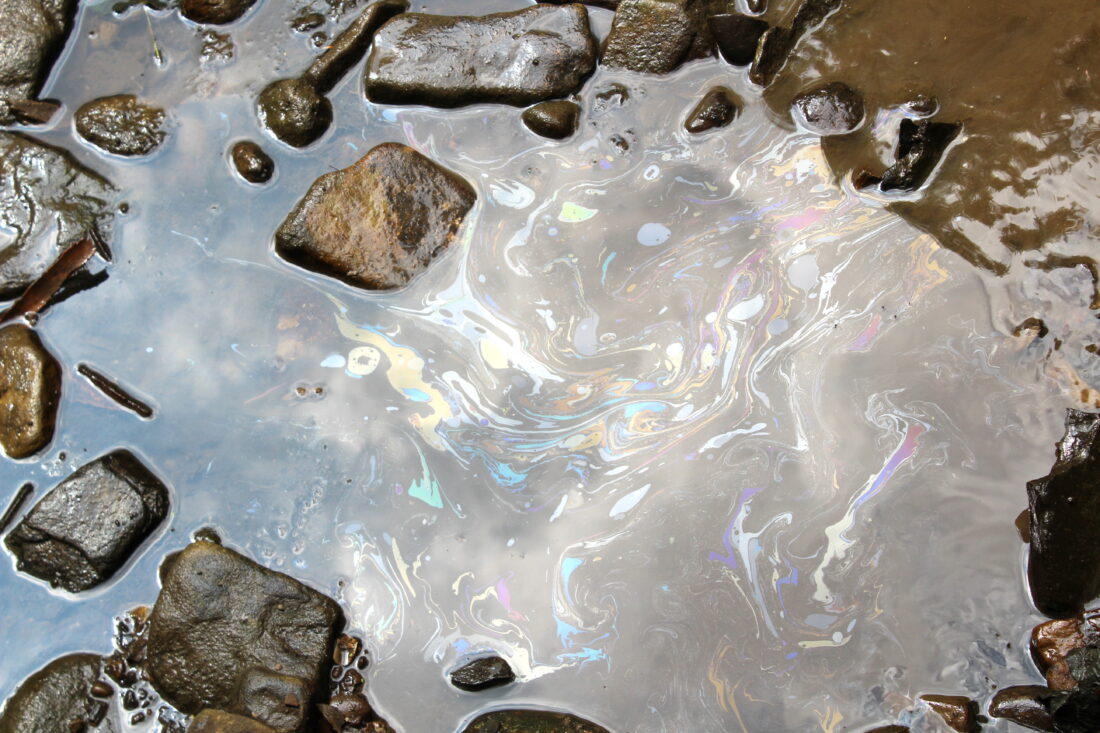
Pictured is sheen present in Leslie Run in April of 2024. Recently, Norfolk Southern submitted its final assessment of the Sulphur Run and Leslie Run to the U.S. Environmental Protection Agency, marking what the railroad says is the completion of stream-related mitigation. (File photo by Stephanie Elverd)
EAST PALESTINE — Norfolk Southern has submitted its final assessment of the Sulphur Run and Leslie Run waterways to the U.S. Environmental Protection Agency, marking what the railroad says is the completion of stream-related mitigation nearly three years after the Feb. 3, 2023, train derailment and chemical release.
The Nov. 27 update, posted quietly to nsmakingitright.com, reports that major site restoration activities — including the demobilization of equipment and work trailers — are finished. Crews will continue to visit periodically for maintenance while long-term surface water, groundwater and drinking water monitoring remains in place under EPA-approved work plans.
Norfolk Southern said the final report documents that no derailment-related sheens were observed in either stream during the last round of sampling.
The final assessment follows a series of complex creek-characterization work plans developed in 2023 under a Unilateral Administrative Order issued by the EPA.
The Leslie Run and Downstream Creeks Characterization Work Plan, revised July 31, 2023, established procedures for sediment, pore water and sheen sampling in Leslie Run, Bull Creek and North Fork Little Beaver Creek. The plan built upon initial sediment investigations conducted in February, March and May 2023 and targeted areas showing visible sheens, odors or staining. Field teams used real-time kinematic survey tools, documented conditions with detailed notes, and collected VOC, SVOC, glycol and sheen samples. Data was intended for integration into a Conceptual Site Model to guide future remediation.
A companion Sulphur Run Characterization Work Plan, released July 11, 2023, sought to determine whether Sulphur Run remained a source of contamination to downstream waterways. It called for sediment and pore water sampling at 11 targeted locations, as well as inspection of covered culverts under East Palestine using remotely operated cameras and air-monitoring equipment. Both plans emphasized strict quality assurance, chain-of-custody protocols and health and safety standards.
These investigations laid the groundwork for cleanup tactics such as sediment washing, streambed agitation, qualitative sheen surveys and removal of contamination found in biologically active zones.
According to the EPA, early in the response, Norfolk Southern under agency oversight began monitoring surface water downstream of the derailment. Cleanup techniques included sediment washing and air sparging, a process that sprays water to add oxygen so microbes can help break down chemicals. These efforts improved water quality, and surface-water samples have remained below levels considered hazardous.
However, disturbing creek sediment still caused iridescent “sheen” to rise to the surface and testing showed both creeks had detections of butyl acrylate, ethylhexyl acrylate, ethylene glycol monobutyl ether and isobutylene following the derailment.
On Oct. 18, 2023, the EPA ordered Norfolk Southern to fully investigate and clean up oily sheens in Sulphur and Leslie Runs under the agency’s authority granted by the Clean Water Act. Crews conducted a qualitative sheen assessment by walking both creeks and disturbing the creek bed every 25 feet. They checked roughly 740 locations downstream and 90 upstream “background” sites for comparison.
Any sheen observed was scored on a 0-3 scale, photographed, and sampled. Initial results showed sheen at 59% of Leslie Run locations and 66% of Sulphur Run sites, compared with only 8% in background areas. Over multiple reassessments, sheen levels declined significantly; by the fourth round, only 3.5% of Leslie Run sites and 27% of Sulphur Run sites still showed sheen.
Cleanup work took place in late 2023, early 2024, and summer 2025. Crews distinguished chemical sheen from natural biological sheen by how quickly it rose, its size, and its odor. Some remaining sheen in background sites likely came from litter, runoff or other non-derailment human activity.
EPA still advised avoiding the creeks during cleanup and said it would revisit guidance with Ohio health officials. The agency said data gaps in certain segments published to epa.gov/east-palestine-oh-train-derailment reflected places where access or creek-channel changes prevented sampling.
The EPA’s final review comes after years of resident concerns over recurring sheens in the creeks.
The visible sheen has been recorded by residents — most notably Dr. Rick Tsai, Randy DeHaven and Christina Siceloff — with the videos racking up thousands of views on social media. The rainbow sheen was also shown in a video posted by then-U.S. Senator and now Vice President JD Vance. The viral footage shows Vance days after the derailment, stirring up what appears to be cloudy and colorful film with a stick.
Resident concerns intensified after an August 2023 fishkill in Leslie Run. A video posted by Dehaven showed thick surface contamination and dead fish adjacent to a silt fence set up for a village bridge-replacement project. State and federal EPA officials attributed the incident to an accidental release of construction material. No water or sediment samples were collected at the fishkill site.
Officials said water testing in Leslie Run showed “no indication of chemicals associated with the derailment,” but acknowledged that sediment disturbance — especially near Sulphur Run — could still release sheen. Local residents, including chiropractor and citizen-monitor Tsai, strongly disputed the agencies’ conclusions. Tsai said he had recorded chemicals “oozing up from the sediment” the day before the bridge demolition and reported a clear chemical odor at the fishkill location.
Separately, in April 2024, about 1,000 fish were killed after heavy rain caused State Line Lake to overflow, sending fish into the bypass pumps that redirect clean water around the derailment site.
“The fish were killed by the pumps in the bypass system, not by exposure to any contaminants,” the EPA said.
The incident became another setback in efforts to mitigate contamination and control sheen and creek cleanup efforts in early 2024 were marked by major challenges.
On March 25, 2024, the first day of a new round of sediment cleaning, sheen released during agitation drifted downstream, prompting the EPA to suspend operations. The failure — captured in a video posted by Dehaven — showed sheen bypassing both soft and hard booms.
An EPA official told village council the cleanup had to be halted because containment tactics were not working and a revised plan was given conditional approval after changes to the containment process.
EPA later clarified in writing that the tactics were “not untested,” but “were not properly implemented.”
Culvert cleaning continued during the pause, except during periods of high water and contractors completed cleaning of the fifth and final village culvert that month. Crews used high-powered vacuum extraction inside the metal culvert under Liberty and Rebecca Streets, with a control point downstream to catch any escaped sheen. The culvert had been identified months earlier as an area of persistent contamination.
In April 2024, the EPA reported that cleanup work in Sulphur Run had resumed.
During that period, the EPA also began restoring natural water flow into Sulphur Run after confirming that contaminated soil had been removed from the derailment site the previous fall. A bypass system had diverted water around the site for more than a year. The agency reiterated that water stored in the now-decommissioned and dismantled blue containment tanks would be disposed of off-site.
Norfolk Southern’s November posting followed an understated September 2025 update announcing that site restoration was largely complete. That update also said final stream sheen assessments showed no remaining derailment-related sheens in either Leslie or Sulphur Run.
Although major cleanup work has ended, monitoring of groundwater, surface water, sediments and drinking water continues — particularly in the east end of the derailment site, where 2-butoxyethanol and other chemicals were detected in early 2025. The railroad installed additional groundwater monitoring wells in that area.
Overall, Norfolk Southern reports that since 2023 it has removed 74 million gallons of contaminated water, more than 240,000 tons of contaminated soil, flushed 5,200 feet of waterways, and sampled more than 2,000 drinking water wells.
The EPA is now reviewing the final creek assessment, which summarizes all sampling and mitigation efforts and documents the absence of derailment-related sheen during the latest evaluations. Federal officials say long-term monitoring is essential to determine whether the creeks have truly recovered. EPA and Norfolk Southern say additional updates will be released as confirmation sampling and monitoring results become available.
For many residents, lingering questions about past contamination events and basement flooding mean the end of fieldwork does not necessarily mean the end of concern. Residents have also expressed the belief that creek clean-up activities like air-knifing led to increased air contamination and exacerbated the poor air quality in the village during remediation, causing persistent nosebleeds headaches, fatigue, coughing, anxiety, skin and eye irritation, chemical bronchitis, neurological symptoms and menstrual changes.
Local News
Rimedio-Righetti won’t seek reelection as Mahoning County commissioner
YOUNGSTOWN — Mahoning County Commissioner Carol Rimedio-Righetti said she will not run next year for a fifth, ...
Kroll defends role amid EP derailment payments argument
YOUNGSTOWN — Kroll Settlement Administration (KSA) has pushed back against a contempt motion filed by class ...
Lisbon adopts new zoning code after 20-year effort
LISBON — Lisbon is set to implement a completely updated zoning code, ending a 20-year effort to modernize and ...

Railroad says stream cleanup complete as EPA reviews final report

SHS Encore Show Choir performs for Rotary Club
