
Communities prep for winter storm
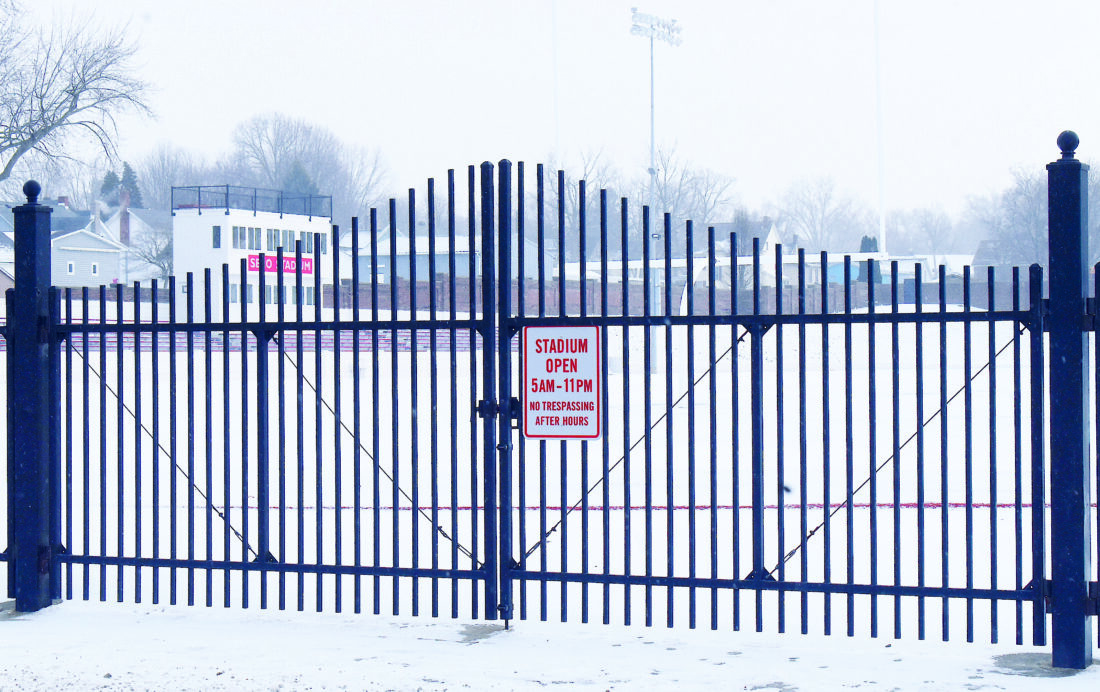
Snow already blankets the football field at Sebo Stadium in Salem on Friday before the winter storm that is forecast for Sunday. (Photo by Ron Firth)
-
- Snow already blankets the football field at Sebo Stadium in Salem on Friday before the winter storm that is forecast for Sunday. (Photo by Ron Firth)
-

- Ron Sevek of the Columbiana County Engineer’s Office road crew loads a truck with material Friday as crews start preparing for the major snowstorm expected Sunday. The county uses a mix of salt and grit and will have 15 trucks clearing roads starting in the early hours Sunday and continuing as the storm progresses. (Photo by Mary Ann Greier)
Ohio Department of Transportation, county engineer’s office and local street department personnel all said they’ll be ready to face the snow and they’re okay when it comes to salt supplies.
Their advice to the public, though, is to stay home, to give plow drivers a chance to do their work against the elements.
“If you can stay home, stay off the roads. If you’re on the roads, give the plow drivers a lot of room and take your time,” county Chief Deputy Highway Engineer Bill Helscel said Friday.
The Columbiana County commissioners made the decision Friday to close the downtown courthouse on Monday. Also closed will be other county offices, including Municipal Court, Juvenile Court, Title Department, Board of Elections and county Health Department, which will reopen Tuesday.

Ron Sevek of the Columbiana County Engineer’s Office road crew loads a truck with material Friday as crews start preparing for the major snowstorm expected Sunday. The county uses a mix of salt and grit and will have 15 trucks clearing roads starting in the early hours Sunday and continuing as the storm progresses. (Photo by Mary Ann Greier)
Helscel said the county pays attention to the weather, but pays more attention when it gets closer to 24 hours before an expected event. The plan now is to come in early Sunday morning, possibly 1 a.m., but the time will depend on how soon the storm starts.
“It’s very hard to predict,” county Engineer Bert Dawson said.
The county will have 15 plow trucks in service, with eight backup drivers in addition to the 15, and with three salt storage domes in place, with the main one in Lisbon at county headquarters. Helscel said the county is okay when it comes to salt, saying the average usage is 5,000 tons each year, dependent on how much snow and activity there is. So far, the county has used under 3,000 tons for the season. He said he ordered another 8,300 tons of salt, adding that he likes to end the season with full salt bins so they’re ready to start when the bad weather hits in the fall. The price was $58.72 per ton, about $1 more per ton than last season, with the county securing the salt through the Ohio Department of Transportation.
When asked how the cold temperatures will affect their efforts, Helscel said, “Salt works less effectively the colder it gets.”
The county adds grit to the mix to help with the traction. Dawson said when it gets cold and the snow is a wet snow, it makes it more difficult. Both he and Helscel said drifting can be a big problem and is expected on Monday. With the new garage that was completed last year, the plow trucks all sit inside, giving them an advantage. They’ll have the trucks already loaded and ready to go when drivers report for duty in the wee hours Sunday.
As of Friday afternoon, Helscel said the forecast was for 8 to 12 inches of snow starting early Sunday, but that could change.
“We’ll watch the weather constantly between now and then,” he said.
ODOT District 11 Public Information Officer Lauren Borell said 13 trucks will plow the state routes in Columbiana County in 12-hour shifts, with a whole new crew driving the trucks after the first 12 hours with their own 12-hour shift for 24-7 coverage. The first crew will start at 6 tonight.
She said ODOT has plenty of salt and more ice control methods to use when the cold makes salt less effective, including beet juice and brine, which is calcium chloride.
Her advice was “if folks can avoid unnecessary travel, do so.”
“Our goal is passable, not perfect,” she said.
Borell also said, “A lot of blowing and drifting snow is expected with the winds and even in the days following the storm. It may take time for conditions to improve.”
She suggested residents follow the road conditions through OHGO on the ODOT website at transportation.ohio.gov There’s also information on social media accounts and live photos from ODOT trucks. She said there’s a lot of ways to stay up-to-date on the road conditions.
Last winter, ODOT salt usage in Columbiana County was 12,686 tons and 111,043 gallons of brine. Total miles driven were 196,457, with 685 treated lane miles and 193 bridges.
Salem
City Service Safety Director Joe Cappuzzello said that Salem’s street department was ready for the extreme winter weather conditions this weekend, and any other winter storms that may come. The street department has eight plow trucks and eight employees, including Street Foreman Shawn Smith, on call to man them once the snow begins; however, Cappuzzello said one of those employees is currently on leave for a total of seven drivers ready ensure Salem roads remain traversable.
“We’re all set; all our equipment is ready, and we’re ready to go,” said Cappuzzello.
Salem ordered 2,000 tons of salt this year at a cost of $58.72 per ton, double the 1,000 tons the city ordered last year at a price of $54.89 per ton. Smith attributed last year’s smaller order to a large stockpile of salt from mild winters in recent years, noting that the city had still started the year with a stockpile of approximately 1,000 tons. Smith said that so far this year the city had taken approximately 1,600 tons of its 2,000-ton order, with Cappuzzello noting that 20 truckloads of salt totaling approximately 400 tons had been delivered on Friday.
Cappuzzello said that with Friday’s delivery the department had approximately 700 to 800 tons of salt on hand, and that it typically takes approximately 35 tons of salt to treat the entire city. Cappuzzello also said that the city’s salt order included a 10% buffer, meaning that if necessary, the city can accept up 10% more (2,200 tons) or less than (1,800 tons) at the current price per ton in accordance with weather conditions, and in the event weather conditions require more salt than that it can be purchased at market price.
The department will be treating the roads with pure salt as it has since 2021. Cappuzzello said that treating with pure salt melts ice more efficiently and that not mixing the salt with grit as in other communities is less abrasive on the road and requires less cleanup in the spring which Cappuzzello said has saved the city money in maintenance and labor costs in the long run despite the higher initial investment. Cappuzzello also reminded residents to exercise caution and that salt becomes less effective in temperatures below 18 degrees Fahrenheit, and has minimal effect when temperatures fall below 15 degrees.
Leetonia
Leetonia assistant village administrator Roman Ferry explained that this year, the village has had a rough time getting enough salt.
“Our supplier has limited their salt supply to only government agencies and no private (entities),” he explained, adding that Leetonia just received their last shipment this week and should be fine for the storm to come.
“The main concern is the temperature, as salt is ineffective with some of the temperatures we are expecting this weekend. If we drop to those levels, we will be resorting to a sand/salt mixture to combat the conditions,” Ferry added.
Weather Daily explains that sand provides “mechanical traction not melting” and works at all temperatures. The only downside is that the cleanup is messier in spring as it accumulates along roadsides and clogs storm drains. It is the “go-to” option for many in extreme cold.
Lisbon
Lisbon Street Department Foreman Jim Oliver said a parking ban to prohibit vehicles parked on all village streets begins at 7 tonight and will continue into Tuesday. He said all the trucks are loaded and the plows are on, with plans to run two crews with three trucks starting early Sunday morning at 1 a.m. He’s been hearing numbers that vary from 12 inches to 16 inches for snow totals.
“We have calcium mixed in with our salt,” he said, adding it’s supposed to be effective at temperatures as low as 25 degrees below zero. “We’ve never had a problem with it not working.”
Oliver said the average salt usage for the village is 75 to 100 tons per season and there’s well over 100 tons of salt in the salt bin now. He’s still using salt ordered in the summer. The whole town can be done with 7 tons, not counting the state Routes, which ODOT usually clears. He said the village should be good on salt. The trucks are in the garage with clean windshields and ready to go. Besides the three plow trucks, the village also uses a 3/4-ton truck and a 1-ton truck to do alleyways.
He offered a suggestion for people when they clean out their driveways, saying to shovel the snow to the right of the driveway as they’re facing the road, not the left, explaining that the village trucks won’t shut the driveway then when plowing past. He also said he understands some people don’t have parking, but the parking ban helps the crews to clean the streets.
State recommendations
Gov. Mike DeWine Friday joined state officials from the Ohio Emergency Management Agency (EMA), Ohio State Highway Patrol (OSHP), Ohio Department of Transportation (ODOT), and Buckeye State Sheriffs Association to encourage Ohioans to prepare for the impending severe weather.
“My main advice to everyone is to stay home if you can,” said DeWine. “By staying home, you and your family will be in the safest place to ride out the storm; you give ODOT and local road crews time to plow the roads; and you can help ensure that law enforcement resources aren’t taxed.”
Tips from Ohio EMA:
During the storm
Close off unused rooms, use blankets and layers, and avoid ovens or grills for heat.
When using generators, follow the manufacturer’s directions.
Do not leave space heaters unattended.
Keep phones charged, use text messages to conserve your battery, and listen to official updates.
After the storm
Inspect your home for damage, leaks, or ice buildup, and clear snow carefully.
Clear snow and debris from storm drains.
Watch for downed power lines, report immediately, and be cautious of slippery surfaces.
Check on neighbors, especially elderly or vulnerable individuals, and share resources.
Tips from the Ohio Department of Aging:
Caregivers should have a plan in place in the event they cannot reach their loved ones by locating the nearest emergency shelter and identifying a trusted neighbor to serve as a backup caregiver.
Wear boots or shoes with good traction to help prevent falls.
Dress in layers and limit exposure to the outdoors during extreme cold temperatures.
Drivers
Ohio State Highway Patrol commander Lt. Dan Morrison of the Lisbon post offered motorists some sage advice if deciding to risk driving on the roads over this stormy weekend.
He advised if you must travel, be sure your car is up-to-date on its maintenance, especially tires, battery, wipers, defroster and cooling system.
Having a winter weather emergency kit, which includes a flashlight, flares, a shovel, blanket, snacks and bottled water, on hand is key in addition to carrying jumper cables, a car phone charger and ice scraper in your vehicle.
Morrison also advised to drive slowly as icy roads tend to make it more difficult to respond constructively and to remember bridges tend to freeze first so be extra cautious when preparing to cross them.
Reducing speed, increasing distance and staying alert can assist a driver in case of an unexpected surprise.
Morrison concluded by urging motorists to continue monitoring weather as the storm gets closer.
Local News
Communities prep for winter storm
E-Edition
If road conditions become unsafe, we may be unable to produce a printed newspaper on Monday in order to protect the ...
Parking ban issued for Salem city streets
SALEM — Street parking will be suspended in preparation for snow today. City Service Safety Director Joe ...
Salem utilities officials discuss consent order termination
SALEM — Utilities department officials discussed the termination of the city’s consent order with the state of ...

Salem Winter Homecoming Queen
Alleged second shooter in East Liverpool murder gets news status hearing Feb. 6
LISBON — The man identified by prosecutors as the other shooter allegedly involved in the 2021 murder of Brycen ...