
County shows preparedness for power station disaster
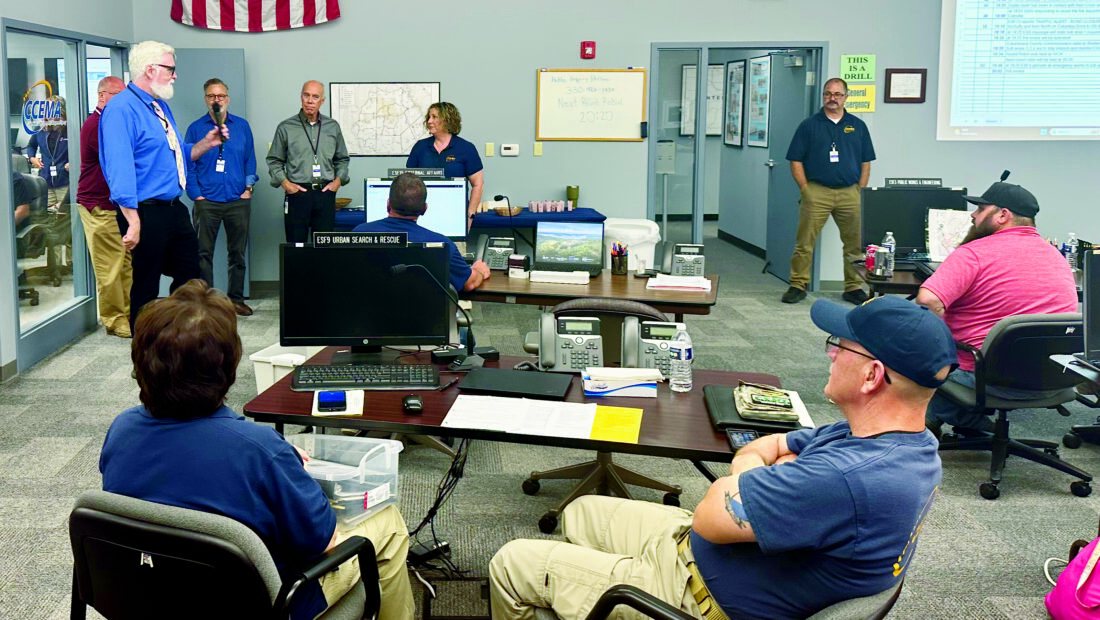
Branch Chief Sean O’Leary of the Federal Emergency Management Agency Region 5 Radiological Emergency Preparedness Program talks with Columbiana County emergency responders and public officials regarding their response during a drill for an emergency at the Beaver Valley Nuclear Power Station. Columbiana County personnel passed the test for all aspects of the biennial exercise to protect the public. (Photo provided by Columbiana County Emergency Management Agency)
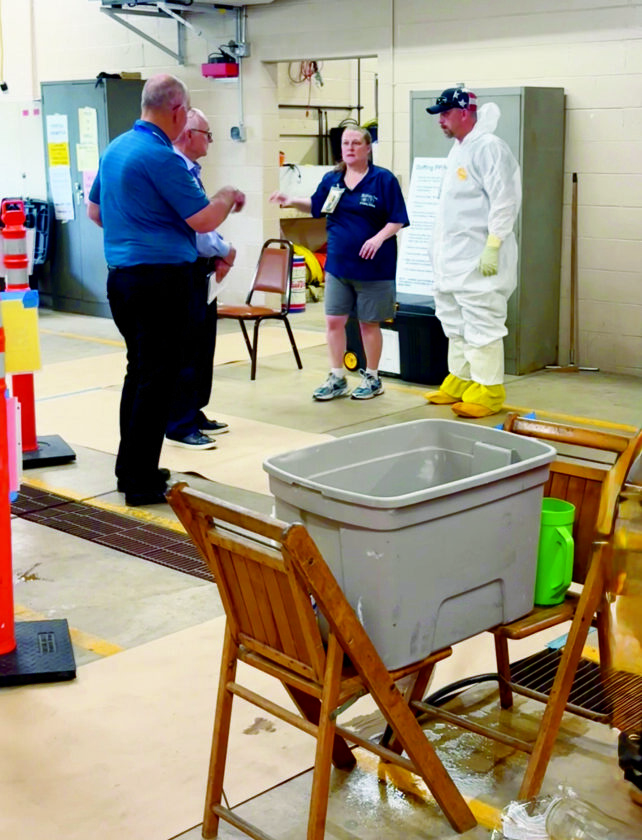
Emergency personnel practice their preparedness at the Middleton Township Fire Department for a problem at the Beaver Valley Nuclear Power Station. The drill was part of a three-day graded exercise for Columbiana County. (Photo provided by Columbiana County Emergency Management Agency)
Branch Chief Sean O’Leary of the Federal Emergency Management Agency Region 5 Radiological Emergency Preparedness Program talks with Columbiana County emergency responders and public officials regarding their response during a drill for an emergency at the Beaver Valley Nuclear Power Station. Columbiana County personnel passed the test for all aspects of the biennial exercise to protect the public. (Photo provided by Columbiana County Emergency Management Agency)
Emergency personnel practice their preparedness at the Middleton Township Fire Department for a problem at the Beaver Valley Nuclear Power Station. The drill was part of a three-day graded exercise for Columbiana County. (Photo provided by Columbiana County Emergency Management Agency)
Trending
LISBON -- Columbiana County emergency personnel, first responders and public officials once again demonstrated they're ready to keep residents safe if a disaster happens at the Beaver Valley Nuclear Power Station.
"They met all their capability targets," Branch Chief Sean O'Leary of the Federal Emergency Management Agency Region 5 Radiological Emergency Preparedness Program said.
O'Leary spoke Friday during a public meeting at the county EMA headquarters Emergency Operations Center regarding the preliminary results of Columbiana County's portion of the Hostile Action Based Radiological Emergency Preparedness Exercise for the Beaver Valley Nuclear Power Station.
Communities in the southeastern part of Columbiana County fall within the plant's 10-mile emergency planning zone, which requires the county EMA to have plans in place in case a real emergency happens at the plant operated by Vistra.
Every two years, those procedures are tested by FEMA, both in the county and at the plant located in Shippingport, Pa., along with the OEMA in Columbus, and everyone's counterparts in Pennsylvania and West Virginia.
The scenario for the exercise Tuesday was described by O'Leary as "bad guys entered the plant and did some bad things."
Columbiana County personnel had to deal with the consequences of damage at the plant, which resulted in a release of radioactive material, exercising the procedures they would follow if a release actually happened. The test occurred over three days at multiple locations, including a simulated emergency personnel decontamination center, a reception center, communications, traffic and access control, a school response and the fully-staffed EOC in emergency response mode.
O'Leary explained the exercises are designed to address five objectives: emergency operations management; exposure control; alert and notification; detect, measure, sample, analyze and assess; and operations. Those objectives are further broken down into capability targets and points of review "to best assess the core capabilities of responding governments and industry stakeholders." There were a total of 85 individual capability targets reviewed and no issues were found.
"Based on the results of the exercise, the state of Ohio and Columbiana County demonstrated that appropriate measures were taken to provide reasonable assurance to protect the health and safety of the public," O'Leary said.
There were 25 evaluators from FEMA and contract support both in Columbiana County and Columbus with 275 participants in the exercise.
A draft after action report will be issued within 30 days to the state on July 9, with a final report available to the public on the Nuclear Regulatory Commission's website within 90 days on Sept. 7.
"We're pleased to hear from FEMA that there were no issues detected," Columbiana County EMA Director Peggy Clark said. "We again appreciate the many, many volunteers who contribute many hours to make this exercise successful and continue to protect the residents of Columbiana County."
When asked how the county compares with other entities, O'Leary said, "I really appreciate Columbiana County's spirit of volunteerism."
He said the EOC was packed Tuesday night and commented, "They were all here to help their community be prepared. It's really a remarkable testament to the leadership in the county."
He thanked the community for mounting such a quality program, adding it takes a lot of effort and a lot of people. He also pointed out that this type of preparation also helps in times of other emergencies, such as the East Palestine train derailment.
The drill began Monday at the Middleton Township Fire Department on Richardson Avenue in Negley where a reception center was demonstrated, with the American Red Cross, Columbiana County Health District, East Palestine Amateur Radio and the Community Emergency Response Team known as CERT all participating,
On Tuesday, the Ohio State Highway Patrol demonstrated traffic and access control points, East Liverpool City Schools showed how the district would respond and there were demonstrations of communications between radio personnel at the county Emergency Operations Center (EOC) and the state.
The full EOC exercise took place Tuesday at the EMA, staffed by members of the EMA staff, including Clark and EMA Deputy Director Brian Rutledge, the county commissioners, the American Red Cross, county health district, the sheriff's office, engineer's office, Ohio State Highway Patrol, school services, fire, EMS, utilities, Community Emergency Response Team and radio personnel, including East Palestine, Lisbon and Triangle amateur radio groups. The executive team, which makes decisions, includes Clark, the sheriff, the county engineer and the county commissioners.
On Wednesday, the American Red Cross set up a shelter at United Local Schools on state Route 9, Hanover Township, with Lisbon Amateur Radio participating. An emergency personnel decontamination facility was demonstrated at the Beaver Local Sports Complex on state Route 7, Lisbon, on Wednesday evening, with Lisbon and West Point fire departments and Triangle Amateur Radio of East Liverpool participating.
IPAWS Emergency Notification System
After talking about the drill, O'Leary discussed the Integrated Public Alert and Warning System (IPAWS) Emergency Notification System. Alerting the public is a critical part of the program when there's an emergency, along with notifying them of what to do.
In the old days, sirens sounded and people listened to the radio for instructions, but communications and technology have changed to the point where in any room, a show of hands will show that everybody has a cell phone. Wireless emergency alerts work on every smart phone.
For the siren system, about 30% to 40% of the people will hear the sirens. Emergency personnel at the Beaver Valley Nuclear Power Station now plan to change the primary notification method about an emergency from sirens to IPAWS.
Unlike the local emergency alert system used by the county EMA, which requires a resident to sign up, IPAWS doesn't require anyone to sign up. It's automatic, just like an amber alert when a child is missing.
Jennie Steifel, Offsite Emergency Preparedness Specialist for the Beaver Valley Nuclear Power Station, explained that the station's emergency alert and notification system currently consists of the outdoor warning sirens as the primary and IPAWS as the backup. That's changing effective Jan. 1, 2027.
The plan will move away from warning sirens and make IPAWS the primary alert notification system. All outdoor warning sirens owned by the Beaver Valley Nuclear Power Station will be decommissioned and dismantled, with the exception of any used by local fire departments for local activation. They will have the chance to have these sirens donated to their stations.
Steifel said there are six sirens owned by the company in the county's Emergency Planning Zone.
To learn more about the county's own local emergency alert system, which can notify of a thunderstorm warning, tornado warning or other impending emergency for a particular community, visit www.ccoema.org.