
Trails and Tales of Columbiana County
Native Americans laid groundwork of travel through county
Trending
Before this land we know as Columbiana County, Ohio, was so named by European Americans, Native Americans had been hunting, trading and navigating it for centuries. Members of the Shawnee, Delaware, Senecas, Mingo and Iroquois traveled through it on a network of trails in order to connect with other tribes for the purpose of trade. Although there were no permanent settlements in Columbiana County there were many meeting places where Native Americans camped and spent time in trade with one another. One such site was located on the high ground where the city of Salem now sits. Evidence of others throughout the county has been found where European Americans built towns, established farms and plowed the land.
In the days preceding settlement by European Americans, Columbiana County was covered by trees - oak, hickory, walnut, chestnut, maple and beech – many of which had grown to heights of 80 to 100 feet. The leaves of these trees created a thick canopy, through which little sunlight penetrated to the forest floor. As a result, these expanses of forests were relatively clear. American Bison and Eastern Elk (now extinct), moved through the vast woodlands along paths of least resistance - just as we see our white-tailed deer doing today. These game trails usually kept to the high ground, avoiding muddy bottoms.
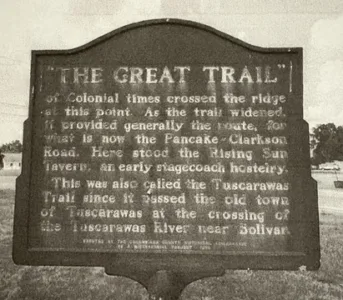
As Native Americans passed through the area, they tended to follow the paths made by the large game. One of the main trails in this complex network passed through Columbiana County and was known to the European Americans as "The Great Trail" or "Tuscarawas Trail." This trail was well worn by the time the first European Americans arrived. It had been trampled for centuries, not only by people but also by bison and elk, both of which were common in the area for centuries prior to the arrival of colonists. The last bison in Ohio was killed in Lawrence County in 1803. The last elk was shot in Ashtabula County in 1835.
The Great Trail enters Ohio in Middleton Township. It crosses the North Fork of the Little Beaver Creek and climbs to the top of the high ridge. This spot along state Route 170 is identified by a historical marker. From there it runs on roughly the same route as present day Pancake-Clarkson Road, continuing west until the area of Lusk Lock Road where it swings to the southwest continuing in that general direction until it enters the wide valley the West Fork of the Little Beaver Creek just east of Gavers in Franklin Township. Here, along the hillside to the north of the valley, the trail divides with one branch continuing west and the other turning south toward the large Native American settlement known as Tuscarora. At the point where the trail divided stood a pole or post which became famously known as "The Painted Post." The post was covered with what European Americans described as hieroglyphics depicting a variety of incidents of importance to the native population - victories over opponents, successful hunts and so forth. From the point where the trail divided both branches soon exited Columbiana County - the trail to the right into what is now Stark County and the trail to the left into present Carroll County.
The first European Americans entered Columbiana County in the early 1750s. They came to trade with the Native American population, primarily for furs. They established no permanent towns but lived, moved and traded among the native population, following the trails and paths which the natives had known for so long.
In 1764, Colonel Henry Bouquet led a force of approximately 1,500 colonials and British regulars on an expedition from Pittsburgh into the Ohio country to obtain the release of persons of European descent who had been captured and held by Native Americans. His force followed the Great Trail, to the present town of Beaver, Pa., crossing through a bottom and over a "branch of the Little Beaver River," thus entering Ohio. This expedition is well documented in a book published in 1765 by William Smith in which a detailed description of the terrain and obstacles encountered is included. This account also gives one of the most detailed descriptions of the famous "Painted Post" and just where it was located.
To the best of my knowledge, there is no place where you can definitively see evidence of The Great Trail today. I grew up in eastern Middleton Township. When I was a kid my father, who was born in 1911 and lived there all his life, told me that when he was young portions of the trail could still be seen. I cannot say I ever saw these trail remnants except in my imagination.
Thanks to our county engineer Bert Dawson, if you can get your hands on a county road map you can follow the route of the Great Trail.
Although we cannot walk "The Great Trail" today, there are many trails here in Columbiana County which you can walk. Among these is the Vondergreen Trail in Beaver Creek State Park. This trail begins near the bridge in the main park. It provides stunning views of this state and federally designated wild and scenic river. Wildlife, wildflowers and historic locks of the Sandy & Beaver Canal are visible along this trail. It has been featured in a number of books as one of the best hikes in Ohio.
Another treasure of a trail is the Little Beaver Creek Greenway Trail which runs from Washingtonville to just east of Lisbon. It is a multi-use paved trail which follows the Middle Fork of the Little Beaver Creek through historic sites in Leetonia, Teegarden, Logtown and Lisbon.
In addition, the North Country Trail passes through our county, loosely following the path of the Great Trail. One can also enjoy over seven miles of hiking trails at Hellbender Bluff County Park in Madison Township.
Trail walking is a great way to experience both our natural and our human history. Columbiana County is fortunate to have a wealth of both.
This monthly column is provided by the Lisbon Historical Society. This submission was written by Eileen Dray-Bardon of the Lisbon Historical Society.