
AROUND THE NATION
Trending
Wildfire smoke makes air unhealthy from the US Midwest to East Coast. Officials say stay inside
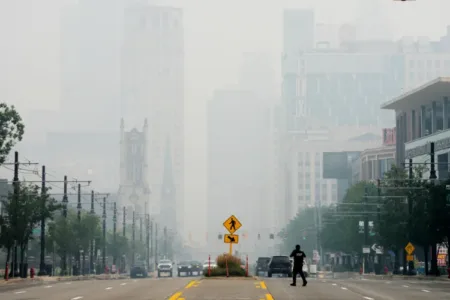
NEW YORK (AP) -- Heavy, pungent wildfire smoke darkened skies in the U.S. on Thursday from the Great Lakes to parts of the East Coast, reducing visibility and prompting warnings that breathing the air outside could be dangerous.
Officials in many cities urged residents to stay inside or wear masks outside as air quality reached unhealthy to hazardous levels, meaning it’s unhealthy for anyone, regardless of health conditions. The smoke is coming from fires that are burning primarily in Canada but also in northern Minnesota. A lingering high pressure system has trapped the smoke close to the ground, said Steven Freitag, a National Weather Service meteorologist in Detroit, where air quality was among the worst in the world for major cities.
“Sure enough, it arrived in force here and it’s really pretty extreme levels,” said Freitag, who noted that visibility in some areas was reduced to a half mile.
“It’s scary,” Omar Mitchell, 50, said as he looked he looked to the sky. He wore a mask while walking to his restaurant in Detroit. “You don’t know necessarily what the side effects may be. That’s days or months later.”
Microscopic particles can lodge deep in the lungs and enter the bloodstream, leading to heart and lung problems and contributing to other long-term health issues.
The air stinks and sky glows yellow in some places
All of Michigan and much of Minnesota were under a hazardous air quality alert. In the Chicago area, air quality ranged from very unhealthy to hazardous.
National Weather Service meteorologist Jake Petr said even if winds from the northwest clear skies as expected later this week, the smoky air could keep returning until the fires are out. That could take months, until it snows in Canada and northern Minnesota, officials have said.
“Anytime we have something that could bring air from that region until the fires are over, it could conceivably dip back into the area,” Petr said.
Bill Ostrowski, 76, wore a mask as he walked through downtown Chicago, where wildfire smoke shrouded skyscrapers. “It stinks. It’s not a good sign when you wake up in the morning and you can smell the air,” said Ostrowski.
In St. Paul, Minnesota, the sky was “glowing yellow,” said Brent Williams, head of the soil, water and climate department at the University of Minnesota. The area “could be looking at weeks to months of continued smoke and flare-ups off and on as the winds blow in different directions,” he said.
A study published this year found that long-term exposure to tiny particles from wildfire smoke contributed to an average of 24,100 deaths a year in the lower 48 states. Long-term exposure can make existing health problems worse and lead to a range of chronic and deadly issues, including respiratory illness, cardiovascular and neurological diseases, and premature death.
2 of 8 men charged in alleged plot to attack the White House UFC event plead not guilty
COLUMBUS, Ohio (AP) -- Two of the eight men indicted in an alleged drone and sniper plot to attack President Donald Trump’s UFC cage-fighting show on the White House lawn pleaded not guilty Thursday to federal conspiracy charges.
Clothed in jail garb and shackled, Tycen Proper, 19, of Danville, Ohio, and Chandler Scaggs, 21, of Chapmanville, West Virginia, entered the pleas before U.S. District Court Judge Edmund Sargus Jr. in Ohio, where the case has been consolidated. They and the other six defendants are each charged with conspiracy to provide material support to terrorists and conspiracy to commit murder on federal government territory and to murder a federal government official.
Sargus scheduled their trial to begin Sept. 14.
It remains unclear from the court record how close the would-be attackers were to being able to carry out the plan they are alleged to have hatched.
Scaggs’ attorney, Eric Brehm, said in a statement that his office is only in the early stages of reviewing the case, “but one issue is already clear: there appears to be a significant disconnect between the severity of the alleged offenses and Mr. Scaggs’ naivety, lack of sophistication, and judgment.” The first charge is punishable by up to 15 years in prison; the second could mean prison for life.
In detailing the group’s July 9 indictments last week, U.S. Attorney Dominick Gerace II was asked how close the alleged plot came to fruition.
“What would have happened or could have happened, that’s never going to be clear, because, thank God, there was an intervention here and this thing was disrupted,” he said. “But, in my view, when I look at what’s been alleged there, it seems pretty likely that someone or multiple people were driving to Washington, D.C., to do something.”
Proper’s lawyer, Joseph Patituce, said his legal team is waiting for the government to produce its evidence for review.
“Mr. Proper is a young 19-year-old man who, despite that youth, recognizes how serious these allegations are,” he said in a statement. “It is important for the public to remember that an indictment is simply the vehicle by which the government puts a citizen on notice of criminal charges and that Mr. Proper is protected by the presumption of innocence that is enshrined in our Constitution.”
According to the indictment, the plot began in May. Members of the group -- citing grievances about government corruption, water-guzzling data centers and the Trump administration’s handling of the Epstein files -- began amassing money, firearms, ammunition, body armor, explosives, drones, medical equipment, communications equipment and other items.
The attack was planned to take place at the cage-fighting show dubbed UFC Freedom 250, which was held on the South Lawn of the White House to celebrate the nation’s 250th anniversary. Law enforcement officials said they learned of the possible threat four days before the event was scheduled to take place.
Rubio gathers countries on left-wing political violence as it becomes a Trump focus in elections
Secretary of State Marco Rubio on Thursday convened leaders from more than 60 countries to take part in the Trump administration’s latest effort to quell what it calls “left wing” political terrorism, a marquee issue for Republicans heading into the midterm elections.
This focus comes even as studies show that there are very few reported cases of such incidents in the U.S., especially compared to historically higher levels of far-right violence.
With sweeping statements about the “alarming rise” of political violence by the left, Rubio and other U.S. officials painted a dark image of the future if the “communists and Marxists” perpetrating these supposed acts are not defeated. He urged officials in attendance -- mostly from European and Latin American countries -- to unite to address the issue, which he says has been a “blind spot” in counterterrorism doctrine.
“So many people in positions of power have repeatedly dismissed acts of violence and even terrorism as legitimate forms of political expression, so long as they served a left-wing cause,” Rubio said in opening remarks. “A bomb planted by a neo-Nazi group was ‘a nefarious and murderous act of evil.’ It is, but a bomb planted by a Marxist revolutionary; well, that’s just merely a tragic excess of idealism.”
A report published last year by the Center for Strategic and International Studies found that left-wing terrorism attacks as of July 4, 2025, had surpassed those from the far right for the first time in more than 30 years. However, a closer look at the data reveals that the uptick reflects a very low starting level and a concurrent drop on the far right.
There was an average of 0.6 left-wing incidents annually from 1994 through 2000, compared with an average of 20.6 on the right, the report shows. From 2016 to 2024, there were an average of four per year on the left and 22.7 per year on the right. Those numbers had dropped dramatically on the right as of early July 2025, with only one incident. Meanwhile, there had been five from the left.
But the report’s authors note that right-wing terrorism could easily return to elevated levels and that it is important to fight terrorism on both sides of the political spectrum.
A Republican push before midterm elections
President Donald Trump and his allies have prioritized talking points against the far left ahead of the congressional elections this November. Trump has repeatedly stated that the Democratic Party’s ascendant left are communists who want to “completely destroy the traditional American way of life” and even engage in assassinations.
Vice President JD Vance has similarly called out communism as a political shift that is “something we haven’t seen in the U.S.” House Speaker Mike Johnson has decried “radical candidates” who are “self-described, self-identifying Marxists.”
For Rubio, his worldview on this issue has been largely shaped by his own history: He is the son of Cuban immigrants who arrived in Miami in May 1956, a few years before communist leader Fidel Castro rose to power in Havana. The former Florida senator said Thursday that it was that same government’s sprawling intelligence and ideological network that “helped to build the far left in our country and in our hemisphere.”
Blanche to meet with Epstein accusers after demand from Republican senator crucial to confirmation
WASHINGTON (AP) -- Acting Attorney General Todd Blanche was expected to meet Thursday with accusers of Jeffrey Epstein after a key Republican senator said it was necessary to earn his support for Blanche’s nomination to lead the Justice Department.
Sen. Thom Tillis had indicated during Blanche’s confirmation hearing on Wednesday that he was leaning toward backing Blanche, who has been leading the department in an acting capacity since April. But after an Epstein accuser testified a day later, Tillis said he expects a meeting to occur before he’s “willing to vote out of this committee.”
Shortly after Tillis’ remarks, Blanche -- who had been meeting with senators on Capitol Hill -- told reporters he had tried to meet the Epstein accusers in a Senate office building but “it didn’t work out” and they were working to coordinate schedules. The Justice Department said later that the meeting was rescheduled for Thursday afternoon, adding: “He looks forward to their discussion.”
“The Department of Justice will always meet with victims or their representatives, and if those victims or their representatives have evidence that anybody committed a crime -- whether it has to do with Jeffrey Epstein or anybody else -- we will of course move forward and investigate and prosecute,” Blanche told reporters.
Epstein’s case and the Justice Department’s handling of millions of files related to his sex trafficking investigation have been a persistent political headache for the Trump administration.
After missteps by then-Attorney General Pam Bondi that enraged Trump’s base, Blanche as deputy attorney general oversaw a massive review and release of millions of files related to the investigation into the disgraced financier with connections to wealthy and powerful people.
Without Tillis’ support, Blanche’s nomination won’t make it through the Senate Judiciary Committee, which questioned Blanche for hours on Wednesday about the Epstein files as well as the creation of a fund to compensate Trump’s allies, a tax immunity deal for the president and a slew of other issues.
Another Republican on the committee who says he has not made up his mind whether to support Blanche -- Sen. John Cornyn -- conveyed concerns that the Trump administration has yet to commit in writing that the fund is dead and could therefore conceivably be resurrected.
One Epstein accuser, Dani Bensky, told lawmakers earlier Thursday that women harmed by Epstein repeatedly asked to meet with Blanche “through multiple channels and he never responded.”
“We deserve to be heard directly, not dismissed and ignored,” Bensky said.
Trump administration revives rule that could deny green cards to immigrants who use public benefits
MIAMI (AP) -- The Trump administration is reviving a rule that could deny green cards to immigrants who use public benefits that could include food stamps, Medicaid, housing vouchers and others.
The policy, known as “public charge,” appeared on Thursday in the Federal Register. It will be formally published on July 20 and take effect Sept. 18. Under the policy, applicants for green cards have to show they wouldn’t be burdens to the country or “public charges.”
The policy was first implemented in February 2020 as one of President Donald Trump’s moves to limit legal immigration during his first administration, but it was reversed after Democratic President Joe Biden came to power.
Its return comes when the Republican administration is implementing a hard-line policy to curb both illegal and legal immigration, and when the cost of healthcare and food is rising.
The federal government “is reaffirming the requirement of self-reliance, protecting public resources and ending policies that encouraged dependency on the backs of hard-working American taxpayers,” U.S. Citizenship and Immigration Services said in a post published on its X account.
“Under President Trump, USCIS is restoring the basic principle that immigrants must be able to support themselves,” the post said.
While the administration’s crackdown on immigration has an increased focus on deportations and immigration enforcement in cities across the country and at borders and entry points, it has also taken actions that target legal immigrants and mixed-status families, in which the parents are foreign nationals with U.S.-born children.
The rule expands disqualification options
Federal law already requires those seeking permanent residency or legal status to demonstrate that they will not become a public charge. The Trump administration’s rule, however, broadens the grounds for disqualification.
The new rule does not describe or specify by name the benefits and programs that could be considered a public charge. Instead, it says that officers who would implement the policy will make “individualized, fact-specific public charge inadmissible determinations, based on a totality of the alien’s circumstances.”
It says that, “using good judgment and discretion, officers will more accurately assess an alien’s likelihood at any time of becoming a public charge.”
The Trump administration first promoted the rule in 2018 as a way to ensure that only those who were self-sufficient came to the U.S. Immigrant rights advocates criticized it, saying it amounted to a “wealth test.” Public health experts said it would lead to worse health outcomes.
Manatt Health, a group that provides advice to state and federal governments, estimated the policy would have deterred as many as 26 million people from seeking healthcare, food, housing or other aid through programs for which they qualified under federal law. About half were U.S. citizens, mostly children or adults living in a mixed-status family, according to the group.
Experts also noted that most people who receive benefits from the government are already legal residents.
A 2020 study from the Migration Policy Institute said that while the “chilling effects” may be vast, the number of immigrants who could be deemed ineligible for legal permanent residence based on use of one of the public benefits under the rule was small.
The institute estimated that no more than 167,000 people -- less than 1% of the 22.1 million noncitizens residing in the United States at that time -- could be determined ineligible for a green card based on their current use of a listed benefit.
There were 22.8 million noncitizens living in the U.S. in 2023, according to the Census Bureau.
Trump administration races the clock to rebuild US tariff wall knocked down by Supreme Court
WASHINGTON (AP) -- The U.S. Treasury last year swelled with revenue from President Donald Trump’s double-digit taxes on imports from almost every country on earth.
But the money dried up after the Supreme Court struck down the biggest and boldest of Trump’s tariffs in February.
The question now is: Can the president’s trade team make good on its promise to replace the lost revenue?
A deadline is approaching rapidly.
After the Supreme Court setback, the president turned first to Section 122 of the Trade Act of 1974 to impose 10% tariffs globally. But Section 122 only authorizes tariffs for 150 days. Trump’s expire on July 24. Congress would have to extend those tariffs -- something lawmakers are unlikely to do as the Nov. 3 midterm elections approach amid voter discontent over the high cost of living.
But the administration has more durable options: Section 301 of the same 1974 trade law permits the president to impose tariffs and other sanctions against countries found to engage in “unjustifiable,” “unreasonable” or “discriminatory” trade practices. Trump used Section 301 to impose big tariffs on China in his first term and is rolling them out again -- as recently as late Wednesday when he announced 25% tariffs on some Brazilian imports, charging the world’s 11th-biggest economy with a host of unfair trade practices.
Trade attorneys and analysts are confident the tariff-happy Trump administration will manage to beat the clock and swap out Section 122 tariffs with bigger Section 301 tariffs by the July 24 deadline. “They’re going to raise the tariff wall again,” said trade lawyer Ryan Majerus, a partner at King & Spalding and a trade official in Trump’s first administration and in President Joe Biden’s.
Trump last year tested - and exceeded - the limits of his authority to impose import taxes, a power the U.S. Constitution gives Congress. He invoked the 1977 International Emergency Economic Powers Act (IEEPA) to slap big tariffs on most of the world’s countries.
He justified the levies, which marked a stunning reversal of decades of U.S. policy in favor of lower tariffs and freer trade, by labeling America’s longstanding trade deficits a national emergency.
The Supreme Court didn’t buy it, ruling in February that the president couldn’t use the emergency powers law to impose tariffs at all. The legal defeat meant the administration had to send refunds to importers that had paid the levies.
As a result, tariffs have at least temporarily gone from a windfall to a drain on the Treasury.
Revenue from import taxes peaked at more than $31.4 billion last October. Then, after the Supreme Court ruling, it started dwindling - to $22 billion in both March and April. As refund checks went out faster than revenue from the Section 122 and other tariffs came in, the number turned negative: A small ($42 million) shortfall in May was followed by a whopping $25.6 billion loss in June.
Trump and Treasury Secretary Scott Bessent have vowed to use other legal authorities to recoup the lost income.
Enter Section 301, which gives the president power to impose - and adjust - tariffs in response to other countries’ trade practices. But the administration must first check procedural boxes - collecting comments and holding hearings. There are no limits on Section 301 tariffs. They expire after four years but can be renewed.
So the president has flexibility in how he uses the Section 301 tariffs. Trump can still change them -- after clearing procedural hurdles -- but he can’t impose or move them up or down on a whim as he often did with the IEEPA tariffs. Uncertainty over Trump’s tariff policy has vexed businesses, leaving them hesitant to make investments and decisions because they don’t know what the trade rules are going to be.
A switch to rule-bound 301 tariffs would mean “there’s less uncertainty but not no uncertainty,” said Sarah Bianchi, a former U.S. trade official who is now chief strategist of international political affairs at the investment research firm Evercore ISI.