
ACROSS THE NATION
Trending
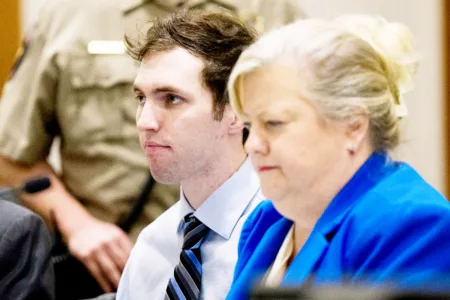
Judge sends Charlie Kirk murder case to trial with defendant facing potential death penalty
PROVO, Utah (AP) -- The murder case against the Utah man accused of assassinating conservative activist Charlie Kirk last year is headed for trial, and the defendant could face the death penalty if he's convicted.
Utah District Judge Tony Graf on Tuesday sided with prosecutors who said they had "overwhelming" evidence that suspect Tyler Robinson shot Kirk once in the neck as the ally of President Donald Trump spoke to a crowd of thousands last September in Orem, Utah. One of Robinson's attorneys entered a not-guilty plea on his behalf following Graf's decision.
Robinson's lawyers tried to block a trial or at least take the death penalty off the table, arguing that prosecutors failed to show Kirk's shooting placed others around him at risk of death. That's an aggravating factor under the law that makes Robinson eligible for capital punishment.
Kirk's family called the ruling "an important step in our family's pursuit of justice."
"Every step in this process carries the weight of all that Charlie's murder has taken from his family, especially his children who will grow up without their father," the statement said. "We are grateful to all who have continued to pray for us, support us, and stand with us through a year of unimaginable grief."
Prosecutors said Robinson shot Kirk from a rooftop more than 400 feet away, knowing that he could have easily missed, injuring or killing other people.
Graf had the option to send the case to trial on a lesser charge of murder, which carries a minimum sentence of 15 years and a maximum of life in prison. The judge said his decision to approve the aggravated murder charge was based on "the documented position of several individuals in and around the canopy area" where Kirk was speaking, among other factors.
"Tyler James Robinson shot and killed Charlie Kirk because he disagreed with him, and he did it by firing a high-powered rifle into a crowd of over 3,000 people, which created a great risk of death that anyone would know about," Ryan McBride, a prosecutor with the Utah County Attorney's Office, told the court.
The hearing Tuesday in state court came after prosecutors in July spent five days presenting what they said was "overwhelming" evidence that Tyler Robinson killed the conservative activist while he was speaking at an open-air event on a college campus.
The 23-year-old defendant turned himself in a day after the shooting at Utah Valley University last September. Robinson's lawyers have not offered alternative theories for Kirk's death.
House passes short-term funding bill to avoid a shutdown before the election
WASHINGTON (AP) -- The House passed a short-term measure Tuesday to fund the federal government into early December, a move designed to avoid a chaotic shutdown as lawmakers campaign for reelection.
Lawmakers needed to act before the fiscal year concludes at the end of September to avoid a funding lapse. They were determined not to bump up against that deadline during the campaign season following this past year's historic shutdowns.
The House passed the bill by a vote of 370-48. The Senate has already overwhelmingly approved the measure, so it now moves to President Donald Trump's desk for his signature.
"It gives the nation and our constituents certainty, certainty that the government will remain open, certainty that our service members will be paid," said Rep. Tom Cole, the Republican chairman of the House Appropriations Committee.
A record 43-day shutdown occurred last fall when the two parties disagreed on renewing an expiring tax credit that lowers the cost of health coverage obtained through Affordable Care Act marketplaces. Then came the shutdown of the Department of Homeland Security, which lasted 76 days before lawmakers agreed to fund much of the department but not its immigration enforcement operations.
Lawmakers were wary of a repeat before voters go to the polls. They also blamed the other party for the recent impasses.
"We're going to avoid the threat of another Democratic shutdown," House Speaker Mike Johnson told reporters in advance of the vote.
After the vote Johnson said the House delivered, despite those who doubted the Republican majority would be able to push past its own divisions and rally support.
"We're continuing to do the grown-up thing, get the job done," he said.
US military completes latest strikes against Iran, while Trump vows more for Tehran's retaliation
WASHINGTON (AP) -- The U.S. military hit targets in Iran on Tuesday and Tehran fired missiles and drones at various sites across the region in response as hostilities flare once again in an intermittent war that has lasted more than six months. One U.S. strike hit a home hosting a wedding, killing five people and wounding dozens, local officials said.
U.S. Central Command said in a statement Tuesday evening that it had completed the latest barrage against Iranian military targets including air defense sites, radar systems and maritime assets.
The U.S. strikes followed others on Sunday that abruptly ended a month without military action and threatened to fully reignite a conflict that has spiked global oil prices and posed political problems for Republicans in November's midterm congressional elections. The renewed fighting comes after President Donald Trump had appeared to pivot toward trying to bend Iran to his will through economic sanctions.
"If the failed Nation of Iran retaliates for this very justified attack, they will be hit again at a much harder and higher level, but it will not be the biggest attack of them all, that is waiting in the wings," Trump warned on social media.
U.S. Central Command said the latest strikes were in response to Tehran trying to attack commercial ships and American forces in the Middle East. Trump offered an additional explanation, telling Fox News in a phone call that U.S. forces struck Iran's radars.
"They tried to rebuild their radar because they can't see anything," Trump told Fox. "We waited until it was almost built and then we hit it."
After the U.S. attacks started, Iran launched ballistic missiles at Jordan. The Iranian Revolutionary Guard claimed to have targeted a U.S. base along Jordan's Gulf of Aqaba coast, according to Iran's state television.
Jordan's military said it shot down 10 of the missiles and the three remaining landed in unpopulated areas. Explosions that appeared to be interceptions of incoming air attacks were seen over Aqaba.
Iranian state media reported that the U.S. had bombed civilian sites along Iran's southern coast and hit a civilian airport. A U.S. strike hit a home where a wedding ceremony was being held in Kuhestak in southern Iran, killing five people, including a child, and wounding at least 68 others, Ahmad Nafisi, Hormozgan Province's deputy governor, told Iranian state television in a phone call.
"Make no mistake: these crimes will not go unpunished," Ebrahim Azizi, chairman of the Iranian parliament's National Security and Foreign Policy Committee, said on X.
U.S. Central Command is aware of the reports of civilian casualties, said Capt. Tim Hawkins, a spokesman. He noted that they "originated from Iranian state media."
"The U.S. military never targets civilians, unlike the IRGC," Hawkins said.
The Kuwaiti Army said on X that its air defenses intercepted drone attacks "following the criminal Iranian aggression." Iran also said it launched a drone attack at U.S. forces in Bahrain, but there was no immediate confirmation from that country.
Postal Service work to comply with Trump's executive order is rushed, sloppy, whistleblower contends
The U.S. Postal Service is poised to launch a hastily built, error-riddled computer system that could jeopardize the process of mail voting relied upon by one-third of all voters, according to a whistleblower statement released Tuesday by Democratic Sen. Richard Blumenthal.
The effort is part of the implementation of President Donald Trump's executive order limiting mail voting and has been temporarily halted by a federal judge. The ruling is being appealed by the administration and the directive may ultimately end up back before the U.S. Supreme Court.
The disclosure from the unidentified whistleblower contends that the Postal Service has been scrambling to try to build a complex system that would normally take a year or more in only three months, sometimes in defiance of the judge's orders halting work. The goal is to have it ready for use in the midterm elections.
The disclosure contends that, due to the new procedures, a single scanning error in a batch of tens of thousands of ballot envelopes could prevent any from reaching voters. It details a system that election officials have already warned could not be implemented before the first mail ballots begin going out Friday in North Carolina.
"The Postal Service has designed a system to disenfranchise millions of Americans," Blumenthal told reporters in advance of releasing the whistleblower information. "This administration seems hell-bent on changing the framework on casting ballots in this country clearly for political reasons."
Trump's executive order, signed in March, directed U.S. Citizenship and Immigration Services and the commissioner of the Social Security Administration to develop state citizenship lists and then required the Postal Service to send mail ballots only to voters who are on such a list. Ballot envelopes would have to comply with new Postal Service rules and include barcodes.
The online portal that is the subject of the whistleblower complaint is intended for states to deliver their lists of verified voters to the Postal Service.
The Postal Service released a statement Tuesday evening in response to Blumenthal's letter, pledging to work with Congress and the courts. It noted that the judge who issued the latest restraining order explicitly allowed the service to continue to develop its online tool for states that want to use it voluntarily.
"Regardless of political party or perspective, we share a common goal: ensuring that Americans can have confidence that their election mail will be handled securely and delivered reliably," the Postal Service said.
The White House said the software buildout process is "neither complex nor unique" for the Postal Service because it already uses bulk mailing and intelligent mail barcodes for large customers. "Under President Trump, the federal government is working to ensure safe, transparent, and honest elections," spokeswoman Lauren Bis said.
House censures Rep. Chuck Edwards for conduct toward former female staffers
WASHINGTON (AP) -- The House voted Tuesday to censure Rep. Chuck Edwards, R-N.C., following a House Ethics Committee investigation that concluded he engaged in persistent unprofessional and inappropriate conduct toward two young female staffers in his office.
A censure registers the House's deep disapproval of a lawmaker's conduct that does not meet the threshold for expulsion from office.
The 413-2 vote was just the latest instance of the House grappling with revelations about lawmakers' behavior toward female staffers, a trend that prompted House leaders to launch a bipartisan review this year focused on making Capitol Hill a safer job environment for women.
Rep. Michael Guest, the chairman of the House Ethics Committee, said the Edwards case did not involve what he called "quid pro quo sexual harassment," but rather conduct and behavior that created a hostile work environment.
"While Representative Edwards denies that his conduct was intended to be sexual or romantic, his pattern of behavior would lead a reasonable person to interpret it as such," Guest said.
Guest said that behavior included providing the aides with lavish gifts, making comments about their appearance and dress, sending notes regarding his affection and inviting them to intimate dinners and vacations. He also said Edwards was aware that the women were uncomfortable with his behavior.
Edwards apologized to the two women, who are no longer on his staff, for actions that put them in an uncomfortable position. He said his intentions were "only grounded in what I understood our friendship to be" and said he admired them. He also apologized to his wife and family, saying they carried a burden they did not create or deserve.
But he also forcefully rejected the committee's most damaging conclusions and the recommendation that he be censured. He emphasized that the investigative report itself concluded there was no evidence he engaged in sexual activity or explicitly propositioned any staff member.
"I am imperfect. I have made mistakes, but I do not believe I committed sexual harassment," Edwards said on the House floor. "The factual findings of this investigation do not justify branding me as though I did."
Edwards was one of the two lawmakers who voted against the resolution. The other was Rep. Ralph Norman, R-S.C.
Edwards told reporters after the vote that he had expected the result would not go his way. House Speaker Mike Johnson sat with Edwards for a few minutes before the vote and told him how he thought it would go.
"It would not have been politically expedient for anyone to vote against a resolution accusing someone of sexual harassment," Edwards said.
Tropical Storm Edouard arrives on the Texas and Louisiana coasts after gaining strength in the Gulf
PORT ARTHUR, Texas (AP) -- Tropical Storm Edouard made landfall Tuesday afternoon along the Texas-Louisiana border after picking up a late burst of strength in the Gulf of Mexico, bringing ashore heavy rains and setting off flood warnings along the coast.
The storm made landfall in the small coastal community of Johnson Bayou, Louisiana, and was expected to rapidly weaken as it moved inland. The National Hurricane Center said the storm arrived with maximum sustained winds of 60 mph (95 kph) and had become slightly weaker as its center moved over southeastern Texas on Tuesday evening. In the meantime, several storms were brewing in the Pacific Ocean, including Lowell, which reached hurricane strength earlier in the day.
The hurricane center said Edouard was expected to dump 3 to 7 inches of rain with up to 12 inches (30 centimeters). Southwestern Louisiana was expected to see lesser amounts.
"That rainfall could produce some flash flooding and river flooding," said Brad Reinhart, a senior hurricane specialist at the National Hurricane Center.
As the center of the storm passed over Beaumont, Texas, about 80 miles northeast of Houston, the city's offices were shuttered and the Texas Office of Emergency Management warned residents to stay off the road.
More than 47,000 utility customers were without electricity in Jefferson County, which includes Beaumont, according to poweroutage.com.
Mike Gilbert decided ahead of the storm to close his surf shop on Texas' Crystal Beach because he didn't want to risk his employees having a difficult time getting home. But, he said, it had ended up just being gray skies and drizzly rain there Tuesday as Edouard made landfall about 60 miles northeast of his shop.
"You literally never know," Gilbert said. "It could have all of a sudden moved over 50 miles and picked up 20 mph in wind and it could have been a whole different story."
In Cameron, Louisiana, the winds had picked up by Tuesday morning and rain was coming through on and off, said Connor Salvador, who owns an RV park there near the coast. He said while there could be a "little bit" of flooding if they get a lot of rain, he wasn't too worried about Edouard.
"We're pretty used to all these types of storms that come through," he said.
Forecasters said newly formed Hurricane Lowell in the Pacific Ocean was expected to remain several hundred miles away from Hawaii for the next several days at least, but swells from the hurricane were likely to impact parts of the islands beginning Wednesday.
"This hurricane is likely to increase the surf and make for dangerous beach conditions and marine conditions for any boaters near the Hawaiian islands over the next few days," said Andrew Hagan, a forecaster with the National Hurricane Center.
Tropical Storm Marie formed in the Pacific Ocean early Tuesday well offshore of southwest Mexico, the center said. Forecasters said it was expected to become a hurricane by Wednesday night, and swells generated by the storm were expected to affect parts of the coast in southwestern Mexico and the Baja California peninsula over the next few days.
Elsewhere in the Pacific, Karina became a hurricane Sunday, fueled by warm waters far from any shore. It strengthened Monday into a powerful Category 4 storm but forecasters said Tuesday that it was expected to weaken.
Meanwhile, the remnants of Tropical Storm Dolly brought rain and thunderstorms to parts of Haiti and the Dominican Republic, the Turks & Caicos, and the Bahamas, the hurricane center said.