
Columbiana County’s tie to John Brown, abolition movement
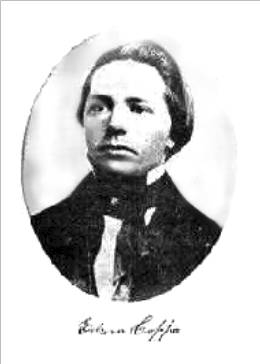
Portrait of Edwin Coppoc
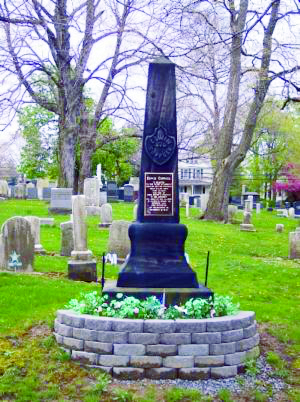
Grave marker on Edwin Coppoc’s grave in Hope Cemetery.
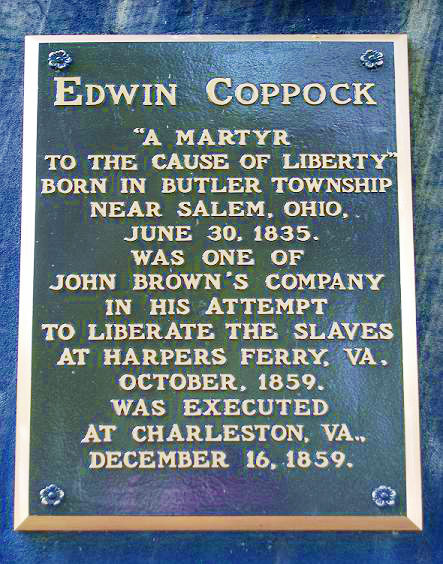
Plaque on Edwin Coppoc’s grave marker
Portrait of Edwin Coppoc
Grave marker on Edwin Coppoc’s grave in Hope Cemetery.
Plaque on Edwin Coppoc’s grave marker
Trending
A double whammy hit young Edwin Coppoc of Winona in early 1842. His father died and because his mother was unable to care for all her six children, 6-year-old Edwin was sent to live with John Butler near Salem.
Butler, a Quaker, was a "conductor" in the Underground Railroad. He reportedly took Edwin with him to secretly transport runaway slaves. These experiences likely helped to shape Edwin's destiny.
From 1842 to 1850, the United States obtained a vast expanse of land from Texas to California over which pro-slavery and anti-slavery factions fiercely battled, issues discussed at length in Quaker communities like Salem.
When Edwin was 15, he joined his mother in Iowa. She had remarried and was gathering her children in the Quaker settlement of Springdale.
Abolitionist John Brown's group was headed to Canada but ran out of money and ended up wintering in Springdale. The abolitionist-leaning Quakers in the community welcomed Brown's men. Together they organized a debating society that discussed the evils of slavery at great length. Edwin and his brother Barclay were apt listeners and came to admire and respect John Brown, eventually joining his group.
Brown was a crazed lunatic or a fearless abolitionist, depending on one's perspective. Brown firmly believed that slaves would rebel if given the chance. He hatched a plan to seize the federal arsenal at Harper's Ferry, Va. (now West Virginia). Brown wanted to use the weapons stored in the arsenal to arm slaves for a rebellion to end slavery. On Oct. 16, 1859, Brown led 21 untrained men in an attack on the arsenal that was defended by 90 U.S. Marines under the command of Robert E. Lee, who at the time was one of America's most brilliant officers. All Brown's men were killed or captured. Brown and Edwin Coppoc were among the captured. Both were convicted of treason and sentenced to hang.
Esther Coppock Shaw, a descendent of Edwin Coppoc, researched Edwin's role at Harper's Ferry and found in a 1903 Iowa history book a startling sidelight to his story.
"Few know how near the coming Southern Confederacy came to losing its greatest military leader...at the hands of an Iowa(sic) boy. Edwin Coppoc saw from his port-hole the blue uniform of the commander and instantly drew a deadly bead on [Robert E.] Lee at close range. Jesse W. Graham, one of Brown's prisoners, who was watching Coppoc, knew Lee and saw his danger. Instantly springing forward, he caught the rifle before Coppoc could fire and during the struggle Lee stepped out of range and so lived to strike the deadliest blow against his country that it ever encountered." From Benjamin G. Gue's History of Iowa from the Earliest Times to the Beginning of the 20th Century, cited by Ester Coppock Shaw.
Coppoc was raised under the influence of devout Quaker parents, grandparents, and other relatives and friends. Shaw ponders the apparent contradiction in Coppoc's conviction that violence was the appropriate response to slavery in a Quaker.
David S. Reynolds wrote in his book, John Brown, Abolitionist, "The brothers Barclay and Edwin Coppoc were examples of that oxymoronic type, the fighting Quaker," He continued, "Quakers had a long history of opposition to slavery and an even longer one of pacifism... The Coppoc brothers had no qualms about taking up arms against slavery."
Coppoc was an exemplary prisoner after his capture at Harper's Ferry. He confided in a letter to his mother that he was sorrowful that he must die a dishonorable death and that he had not understood what the full consequences of the raid might be. On Dec. 16, 1859, 24-year-old Coppoc and a fellow prisoner were cheerful before leaving their cells. When they were seated on their coffins for the ride to the gallows in a wagon, Coppoc's expression changed to despair. He gathered himself and at the gallows he was calm and collected, exhibiting unflinching firmness.
Coppoc was buried at the Friends cemetery in Winona. Several men took turns guarding the grave because it was rumored that pro-slavery sympathizers were planning to rob it. Friends insisted that his body be reinterred in Salem's Hope Cemetery. A plain sandstone shaft about seven feet high was erected by his friend, Howell Hise, of Salem, to mark his final resting place.
------
This monthly column is provided by the Lisbon Historical Society. This submission was written by Mary Miller VanBuren of the Lisbon Historical Society. Her email is maryvanburen43@gmail.com.