
As colonies revolted from Britain, Frederick played an active role in Revolutionary War
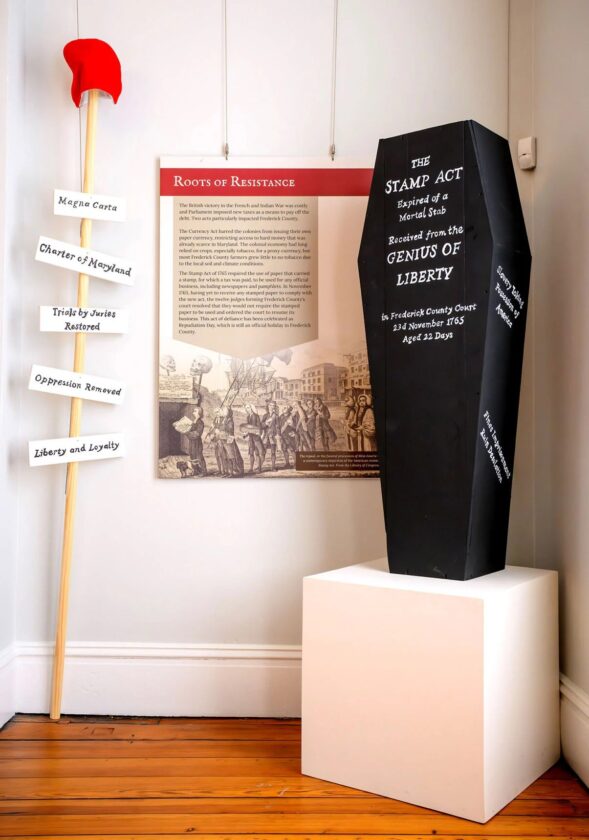
An exhibit at the Heritage Frederick historical society on Frederick’s contributions to the Revolutionary War shows a casket of the type used for a 1765 mock funeral to protest the Stamp Act, a British tax imposed on the colonies. (Frederick News-Post photo by Ric Dugan)
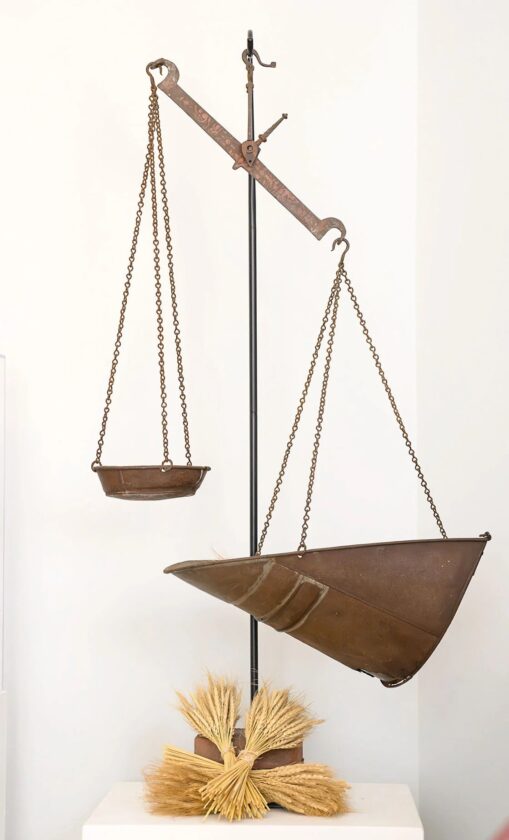
An exhibit at the Heritage Frederick historical society on Frederick’s contributions to the Revolutionary War shows a grain scale from a mill that belonged to Philip Feaga, a German farmer. Feaga, who purchased the mill property in 1785, was a Hessian ally for the British during the American Revolution, according to the Maryland Historical Trust. (Frederick News-Post photo by Ric Dugan)
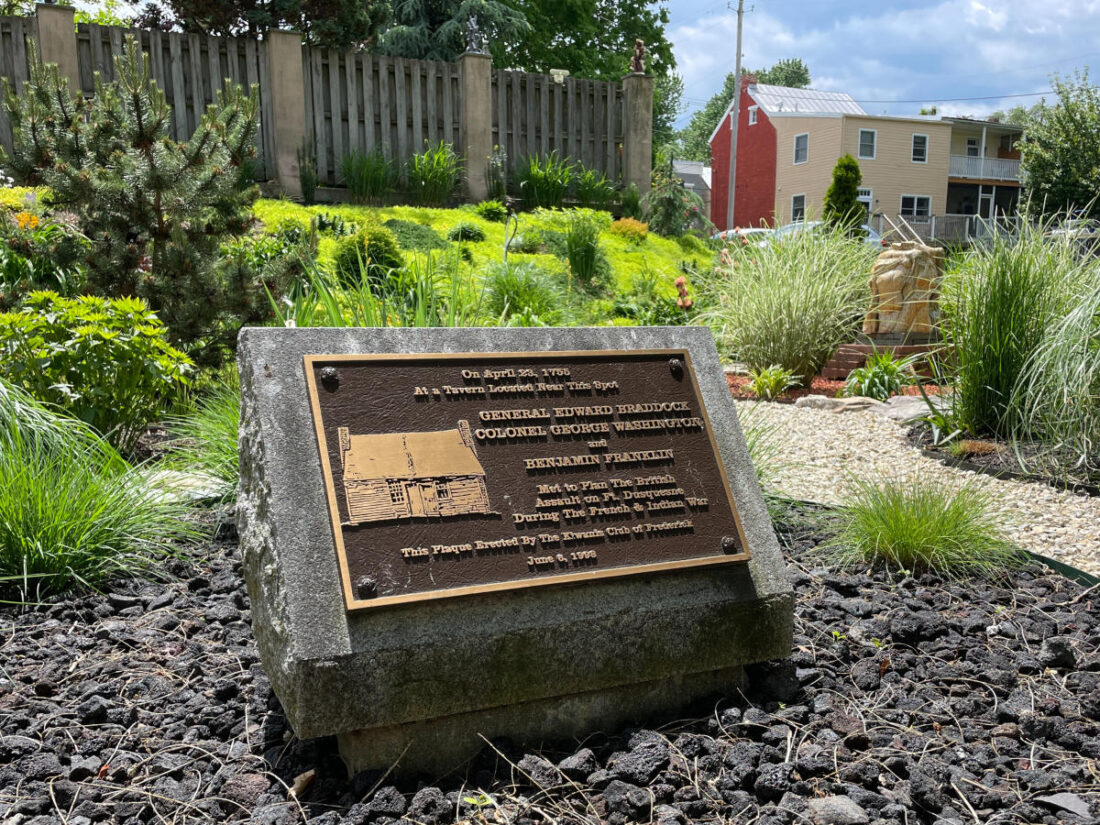
This plaque in Frederick, Md., highlights the 1755 meeting between Gen. George Braddock, then-Col. George Washington and Benjamin Franklin sits near the spot in Frederick where they met to discuss plans to attack Fort Duquesne at Pittsburgh. (Photo courtesy of Visit Frederick)
An exhibit at the Heritage Frederick historical society on Frederick’s contributions to the Revolutionary War shows a casket of the type used for a 1765 mock funeral to protest the Stamp Act, a British tax imposed on the colonies. (Frederick News-Post photo by Ric Dugan)
An exhibit at the Heritage Frederick historical society on Frederick’s contributions to the Revolutionary War shows a grain scale from a mill that belonged to Philip Feaga, a German farmer. Feaga, who purchased the mill property in 1785, was a Hessian ally for the British during the American Revolution, according to the Maryland Historical Trust. (Frederick News-Post photo by Ric Dugan)
This plaque in Frederick, Md., highlights the 1755 meeting between Gen. George Braddock, then-Col. George Washington and Benjamin Franklin sits near the spot in Frederick where they met to discuss plans to attack Fort Duquesne at Pittsburgh. (Photo courtesy of Visit Frederick)
Trending
Editor's note: This is the second in a series of 12 weekly stories focusing on America's 250th birthday, as told through the lens of our communities and the role many of the places we call home played in shaping the nation before, during and after the Revolutionary War. This week we stop in Frederick, Md., in the 1770s, just as the colonists were preparing to revolt against the monarchy. Frederick was home to the first formal protest against the Stamp Act -- a tax levied on colonists for the use of official stamped paper -- and, during the war, served as a vital source of supplies for the Continental Army. Also this week, we learn of Dr. Matthew Thornton of New Hampshire, the final of 56 signers of the Declaration of Independence.
***
The city of Frederick, Md. had a much smaller footprint in the 1770s than it does today, but played a significant role in the American Revolutionary War.
In addition to being the home of founding fathers, such as Thomas Johnson and John Hanson, it was the site of the first formal protest against the Stamp Act, a tax the colonies had to pay Britain through the use of official stamped paper.
This was a key source of tension between the British Crown and settlers throughout the original 13 colonies.
According to Jody Brumage, the archivist at the Heritage Frederick historical society, the fledgling town was "very much part of the early nation's breadbasket" and that status was its main daily contribution to the war.
He said that a visitor in 1776 who stood on the hill on South Market Street in downtown Frederick, near the present-day Maryland School for the Deaf, would have seen vast tracts of farmland surrounding a small-town street grid.
"A lot of the building of the town at that time would have been concentrated around Carroll Creek, around Patrick and Market streets and Church Street," he said, "but beyond that, you would have seen a lot of empty land that had not been fully settled."
From the time of the town's founding in the 1740s, he said, there were mills set up along Carroll Creek, and by the time of the war, many water-powered mills produced high volumes of flour.
Not only was Frederick important for the volume of grain products it could provide to the Continental Army, he said, but its geographic location in roughly the middle of the colonies made it a key distribution hub for both the North and South.
Frederick produced many other supplies for the war, as well, Brumage said.
Thomas Johnson, the first elected governor of Maryland, bought many tracts of land in Frederick County in the 1770s and founded the Catoctin Furnace near Thurmont, in the northern part of the county, with his brother -- in part to produce weapons and supplies for the war.
The furnace was in blast by the time the Declaration of Independence was signed in 1776. As governor from 1777-79, Johnson was heavily involved in establishing and maintaining supply chains for the military.
"We know (the furnace) supplied some Dutch ovens and some basic supplies for soldiers and also produced cannon that was used at the Battle of Yorktown," Amanda Venable Kramer, the museum manager of Rose Hill Manor Park and Museums, said.
Johnson, who played a key role as a Maryland delegate in the negotiations leading to the Declaration of Independence, bought the land for Rose Hill Manor in 1778, Kramer said. He lived there in his older age following the mansion's construction in the 1790s.
His family likely lived in a cabin or another structure there during the war, though few records describe their time there, Kramer said.
Brumage said Frederick would have been a very busy town during the 1770s. In addition to the steady flour production, it was a lively market town.
At least once a week, he said, farmers would come to the city market to sell a wide range of produce on the site of the present-day Brewer's Alley restaurant on North Market Street.
That market became the street's namesake, he said, and persisted in some form until the middle of the 20th century.
"The market was sort of a function of the civic life of the town …," he said.
But the economy wasn't entirely agricultural, he said. There were furniture makers, clock makers, blacksmiths and several other "cottage industries," he said.
Frederick also offered hospitality, with several taverns along Market and Patrick streets, the heart of the downtown area.
Brumage said there was a small tavern on West All Saints Street near Carroll Creek where George Washington, Edward Braddock and Benjamin Franklin met in 1755 to coordinate an attack during the French and Indian War.
Anyone walking through downtown Frederick in the 18th century, Brumage said, likely would have heard as much German as English spoken in the streets.
That fact would become relevant near the end of the war, when about 1,400 captured Hessian soldiers -- German mercenaries who fought for the British -- were housed at the then-new military barracks on the present-day Maryland School for the Deaf campus.
While Frederick generally produced abundant grain, Brumage said, "we do know from records it was a strain on the local community to supply enough food" for the British prisoners.
The state of Maryland passed a law that allowed the Hessians to ransom themselves out of British service.
The majority did not pay the ransom and ended up being sent back to Europe, he said, but a significant number paid it and integrated into the Frederick community.
"They certainly found familiar cultural ties in the area," Brumage said.
One of the major connections between Frederick's Revolutionary War history and its Civil War history is that the son of one of those freed Hessians became a key chronicler of town life during that latter conflict.
Jacob Engelbrecht, the son of the Hessian Conrad Engelbrecht, kept an extremely detailed diary of Civil War life, then became the town's mayor.
The city also saw visits prior to the revolution from Gen. Edward Braddock and then-Col. George Washington, as the two in 1755 met with Benjamin Franklin to plan the attack on Fort Duquesne at Pittsburgh during the French and Indian War.
Heritage Frederick currently has an exhibit about Frederick's contribution to the Revolutionary War called "Cultivating Independence" that will run through Dec. 11, 2027.
A virtual version of the exhibit is available at https://frederickhistory.org/cultivating-independence.
In the next installment, we step back briefly to examine the impact areas in Southwestern Pennsylvania had before, during and after the Revolutionary War. This is an area in which George Washington earned his battle stripes during the French and Indian War, and also the site of the only battle he lost -- Fort Necessity near Uniontown, Pa.